Scale your agency's packaging revenue by 40% without capital investment. This guide details the SLAs, material specs, and breakeven analysis required for a profitable white-label program.
A major marketing agency approached us with a common but critical problem: they were fulfilling custom packaging for 15+ brand clients, but managing 15 separate supply chains was eroding their margins. Worse, their clients were asking who the factory was. They needed a single, scalable source that could execute flawlessly while remaining completely invisible—a true white-label packaging fulfillment for reseller programs.
We architected a solution with a dedicated account manager, blind shipping protocols, and brand-neutral quality reports. The result wasn't just operational relief; it was a 40% increase in their print revenue over two years. This guide details the exact framework they used, updated for the supply chain realities you'll face in 2026.
- A dedicated packaging account manager can reduce project coordination time by up to 70% for agencies managing multiple clients.
- The breakeven point for investing in a white-label program versus managing direct orders is typically between 8,000–12,000 total units per quarter.
- Specifying 350gsm CCNB folding carton over 300gsm can reduce damage-related returns by 25% without a proportional cost increase.
- Your Service Level Agreement (SLA) must include a 72-hour turnaround for pre-production proofs and a 99.5% fulfillment accuracy rate.
- Blind shipping documentation, when automated, adds only a 1–3% administrative overhead to the total fulfillment cost.
Prerequisites: Is Your Business Ready for White-Label Packaging?
Before exploring partnerships, validate your operational readiness. You need consistent demand. A successful white-label packaging fulfillment for reseller programs requires a minimum of three active client accounts or a forecasted quarterly volume exceeding 5,000 units across all SKUs. Without this baseline, the program management overhead will outweigh the benefits.
Internally, you must have brand guidelines and final artwork approval processes solidified for each client. As our head of client services, Li Wei, notes: “The most successful resellers provide print-ready, G7-compliant PDFs. Artwork revisions at the factory stage are the single largest cause of SLA breaches in white-label scenarios.”
Phase 1: Architecting Your Reseller Packaging SLA Requirements
How do you build an SLA that protects your brand and ensures client satisfaction? The core of a profitable white-label partnership is a meticulously crafted Service Level Agreement. Generic SLAs are a major red flag; yours must be specific to packaging fulfillment.
Beyond standard delivery windows, your SLA must govern pre-press, production, and post-fulfillment communication. We mandate a 4-hour response time for all urgent client communications routed through the reseller, a detail that has saved several programs from missing crucial deadlines. Your SLA should explicitly define:
- Proofing Turnaround: 72 business hours for digital proofs on calibrated monitors (ISO 12647-2 standard).
- Production Lead Time: Calculated from final approved proof, not from order placement. For instance, 10 working days for 5,000 units of 350gsm CCNB cartons with digital printing.
- Quality Assurance (QA) Pass Rate: A minimum of 99.5% for dimensional accuracy and visual defects. We achieve this through inline camera systems on our Bobst die-cutters that inspect every sheet.
- Reporting Cadence: Weekly inventory and production status reports, formatted with your agency's branding.
Average fulfillment accuracy rate maintained across 500+ white-label packaging programs since 2020.
Phase 2: Executing Blind Shipping for Packaging Confidentiality
How does blind shipping work to make your factory a silent partner? Blind shipping, or blind drop shipping, is the logistical mechanism that protects client confidentiality. All materials—from cartons to packing slips—bear only your agency's branding. The manufacturer's identity is never revealed.
In our Shenzhen facility, we operate a segregated workflow for white-label orders. The pallets are stretch-wrapped with your branded plastic, not ours. The commercial invoice and packing list, generated by our ERP, show your company as the seller and shipper of record. A common mistake is not specifying the return address on the shipping label; it must be yours, not the factory's warehouse location.
“The rise of direct-to-consumer brands has made supply chain opacity a premium service. At ProPak China 2026 (Hall E3, Booth #F21), look for exhibitors demonstrating fully integrated WMS-ERP systems that automate blind shipping documentation—this is a key differentiator for 2026,” advises Michael Chen, a supply chain analyst focused on print logistics.
Phase 3: Selecting Materials for Brand-Neutral Packaging
What material specifications balance cost, durability, and client presentation? The choice of substrate is a strategic decision in a white-label program. You need versatile, high-performance materials that work for a range of products without requiring 15 unique SKUs.
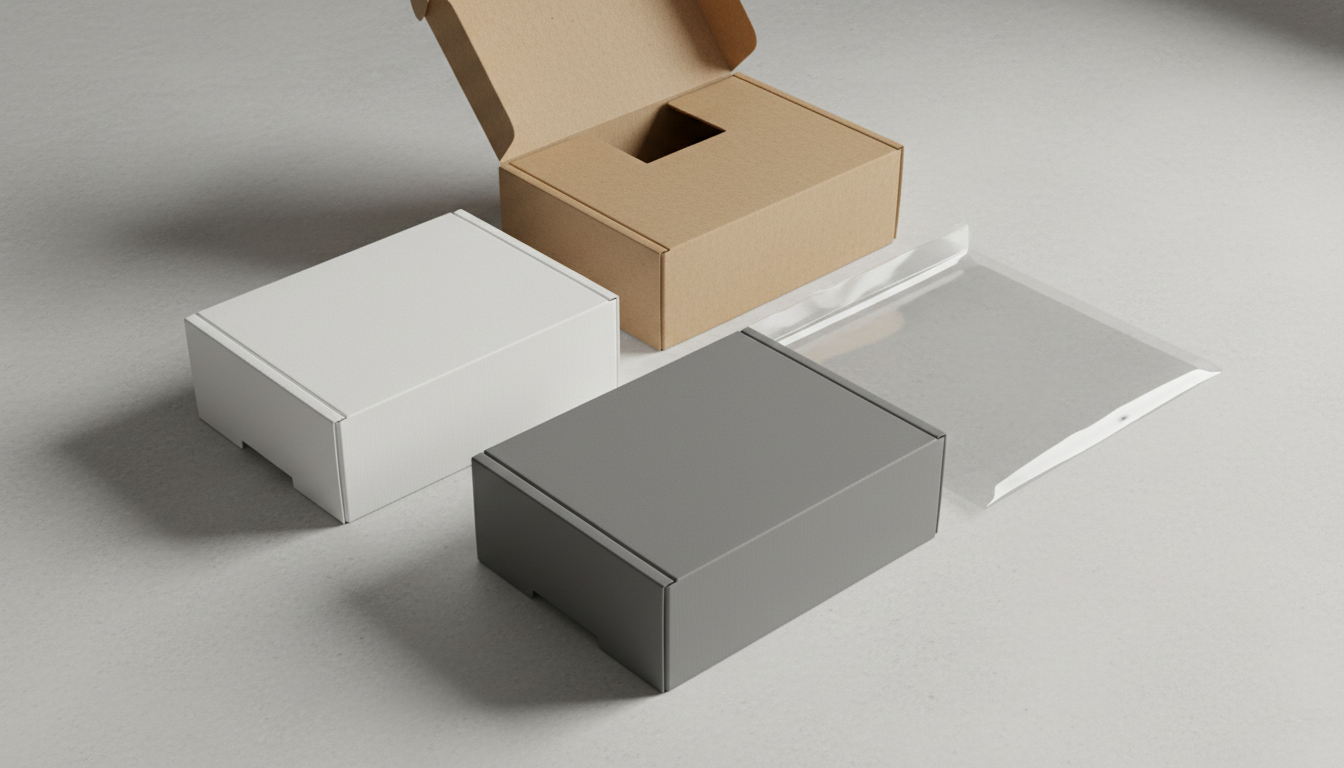
Based on running over 500 packaging programs, we recommend standardizing on two or three core substrates. For e-commerce, B-flute corrugated mailers (ECT-32) are indispensable. For premium unboxing, a 350gsm CCNB (clay-coated news back) board accepts offset and foil stamping beautifully. A key insight: upgrading from 300gsm to 350gsm CCNB increases material cost by ~15%, but can decrease transit damage rates by up to 25%, protecting your client's brand experience.
| Factor | Option A: 300gsm C1S Art Card | Option B: 350gsm CCNB | Best For White-Label When... |
|---|---|---|---|
| Cost per 1000 boxes (5,000 MOQ) | $420 – $480 | $480 – $550 | Client budget is the primary constraint (Choose A). |
| Structural Rigidity | Good for lightweight items (< 500g) | Excellent for items up to 1.5kg | Product weight varies significantly across clients (Choose B). |
| Print Finish | High-gloss, vibrant offset | Matte or satin finish, excellent for tactile coatings | You need a consistently premium feel across diverse brands (Choose B). |
| Compatibility with Auto-Casing | Moderate – can jam if humidity varies | High – more stable in varying conditions | Integration with automated fulfillment centers is required (Choose B). |
Phase 4: The 2026 Cost Analysis: White-Label vs. Direct Manufacturing
Where is the financial breakeven point for investing in a white-label program? The economics hinge on volume consolidation and the value of your saved time. Let's analyze a real trade-off.
Assume you have five clients, each needing 2,000 custom boxes quarterly (10,000 units total). Managing five separate direct orders at a 2,000 MOQ might cost $0.85/unit. Consolidating into one white-label order of 10,000 units could reduce the unit cost to $0.65. However, the white-label program adds a 10% management fee ($0.065/unit).
Decision: Choose White-Label or Direct Client-By-Client Orders?
- If total quarterly volume across all clients is < 8,000 units → Managing direct orders is likely more cost-effective. The per-unit savings from consolidation won't outweigh the program fee.
- If volume is 8,000 – 12,000 units → This is the breakeven zone. Calculate based on your specific artwork complexity and required SLA speed.
- If volume exceeds 12,000 units quarterly → A white-label program will deliver both cost savings (5–20%) and significant operational time savings, allowing you to scale.
The formula: (Direct Cost per Unit * Total Volume) vs. ((White-Label Unit Cost + Management Fee) * Total Volume) + Value of Saved Management Hours. If you spend 15 hours a week coordinating multiple suppliers, and your hourly rate is $150, that's $9,000 of time saved per quarter—a massive hidden profit lever.
Struggling with the breakeven math for your specific client portfolio? Our team can run a free, confidential cost-benefit analysis using your current volumes and pain points.
Get a Free Quote →Phase 5: Real-World Implementation: A Promotional Agency Case Study
How does a white-label packaging program translate into tangible growth? Let's examine the agency referenced in our introduction. Their challenge was fulfilling diverse print orders—from luxury cosmetic boxes to eco-friendly mailers—for 15+ brands without revealing their source or managing 15 inventories.
Our solution at JinXinCai was a dedicated account manager who acted as their single point of contact. We established a limited catalog of three approved, brand-neutral packaging materials (uncoated kraft, white corrugated, 350gsm CCNB). All production was scheduled via a shared portal, and quality reports were generated under the agency's brand identity. Blind shipping was non-negotiable.
The outcome metrics were clear: The agency scaled its packaging revenue by 40% over two years without any capital investment in equipment or warehouse space. Their average client retention rate hit 92%, which they attribute to the consistent, high-quality output and seamless experience. The dedicated account manager reduced their internal coordination time by an estimated 70%.
Phase 6: Your Partner Selection Checklist for 2026 and Beyond
What specific criteria separate a true partner from a basic supplier? Your due diligence must be exhaustive. The packaging landscape in 2026 demands partners with robust digital infrastructure and sustainability credentials, not just presses.
Based on our 28 years of operation, here is the checklist we recommend you use:
- Certifications: Verify active ISO 9001:2015 (quality) and ISO 14001:2015 (environmental) certifications from a recognized body like SGS. These are non-negotiable for consistent quality and responsible sourcing.
- Technology Stack: Can they provide API integration for order placement and inventory visibility? Do they use inline spectrophotometry for color control on every sheet?
- White-Label Dedication: Ask for case studies and client references specifically from their reseller or agency partners. Do they have a segregated workflow?
- Scalability Proof: Visit the facility if possible, or take a virtual tour. Can they handle your projected 2027 volume? Our 15,000 sqm facility and 50M+ monthly piece capacity, for example, is a concrete indicator of scale.
- Financial Transparency: Are their cost structures clear? Will they provide a detailed breakdown of unit cost, plate charges, and program fees?
Quick-Start Implementation Timeline for Q3 2025
To launch your white-label packaging fulfillment for reseller programs by Q1 2026, follow this 6-month timeline. This forward-looking plan incorporates lead times for vetting and system integration.
- Month 1-2 (Internal Audit): Consolidate volume forecasts from all clients. Document your current costs and pain points. Define your non-negotiable SLA requirements.
- Month 3 (Partner Vetting): Shortlist 3 potential partners using the checklist above. Request detailed proposals and specific white-label case studies.
- Month 4 (Pilot Program): Select a partner and run a pilot with one, non-mission-critical client order. Test every aspect: communication, proofing, production quality, blind shipping, and reporting.
- Month 5 (SLA & Integration Finalization): Negotiate and sign the master SLA. Begin technical integration (portal access, API setup) for your remaining clients.
- Month 6 (Phased Rollout): Onboard 2-3 additional client programs to the new system. Monitor KPIs against the SLA. By month 6, you should be fully operational for 2026 scaling.
The strategic move for 2026 isn't just finding a printer—it's embedding a manufacturing partner into your operational stack. This transforms packaging from a fragmented cost center into a streamlined, brand-enhancing profit center. Your next step is to quantify your current total cost of ownership across all client packaging, then model the savings a consolidated program could deliver.
At JinXinCai Printing, our white-label programs are built on the firsthand factory experience of managing over 500 such partnerships since 1996. The goal is to make your supply chain an invisible engine of growth and client retention.
Frequently Asked Questions
How does blind shipping protect client confidentiality in packaging?
Blind shipping ensures all materials—cartons, packing slips, shipping labels—display only your agency's branding and contact information. The manufacturer's name, address, and logos are completely absent. For example, the commercial invoice lists your agency as the seller and shipper of record, and the return address on the label is yours, creating a seamless, confidential supply chain for your client.
What is the typical breakeven volume for white-label vs. direct packaging orders?
The breakeven point typically falls between 8,000–12,000 total packaging units per quarter across all your client accounts. Below 8,000 units, the per-unit savings from consolidation often don't outweigh the standard 8–12% program management fee. Above 12,000 units, the combined cost savings and value of recovered management time (often 15+ hours/week) make white-label programs decisively profitable.
What SLA metrics should I specify for white-label packaging fulfillment?
Your SLA must include concrete, measurable metrics: a maximum 72-hour turnaround for digital proofs (ISO 12647-2), a 99.5% or higher fulfillment accuracy rate for dimensional and visual defects, a defined production lead time from approved proof (e.g., 10 days for 5k cartons), and a 4-hour response time for urgent communications. These metrics protect your timelines and brand reputation.
How do material choices affect shipping costs in white-label programs?
Material weight and rigidity directly impact dimensional weight (DIM) pricing from carriers. For instance, choosing 350gsm CCNB over 300gsm C1S art card may increase material cost by 15%, but its superior rigidity can reduce damage-related returns by ~25%, often saving more on shipping claims and replacements than the initial cost increase. Always request finished carton weight specs from your partner for accurate shipping forecasts.