
By 2026, smart packaging will shift from a regulatory checkbox to a strategic asset for food & beverage brands, driven by printed electronics, shelf-life tech, and hybrid manufacturing that offers demonstrable ROI.
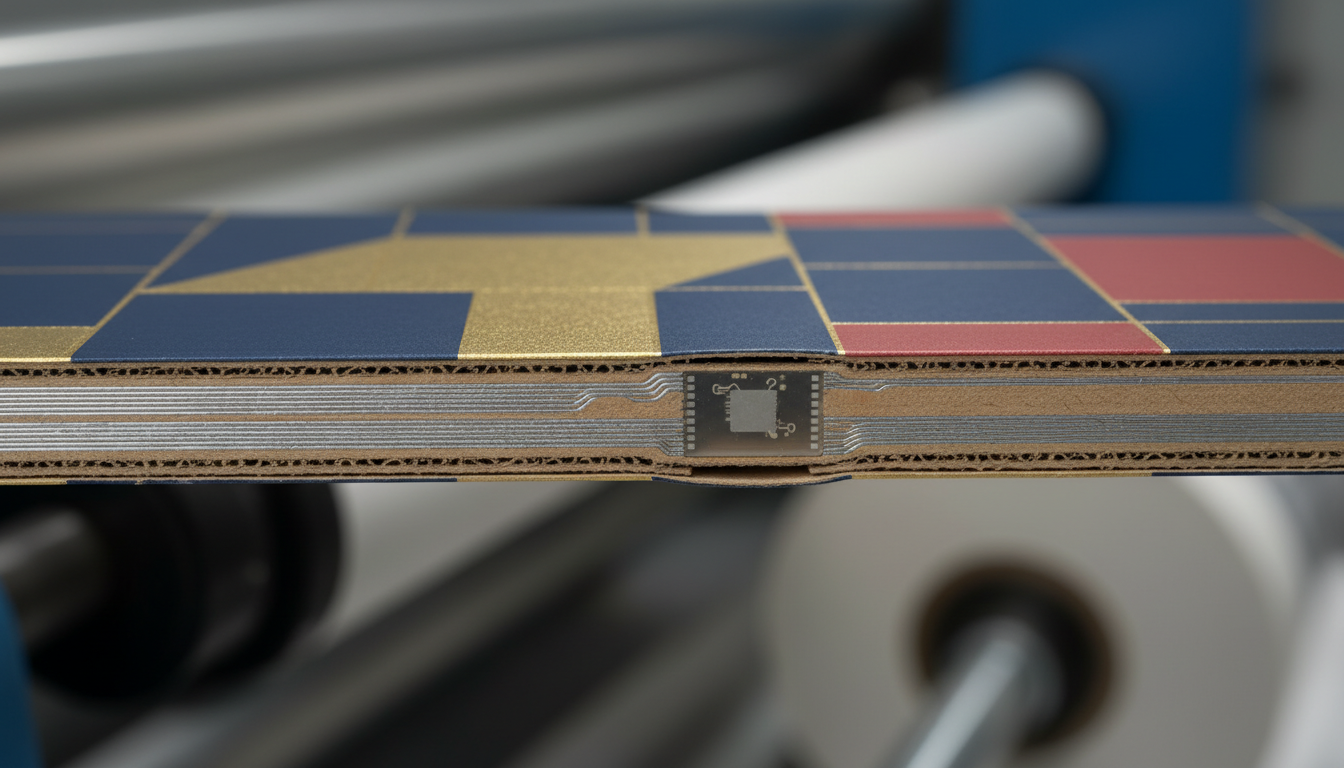
In our factory, we've watched the definition of 'safe packaging' evolve. It used to mean ink that wouldn't leach and board that wouldn't delaminate. Today, for forward-looking brands, it means a package that actively monitors, communicates, and protects. The regulatory push from FSMA 204 and EU DPPs is the catalyst, but the real value lies in waste reduction and direct consumer trust. This isn't about adding a QR code; it's about embedding intelligence into the substrate itself to create a dynamic, data-generating asset.
Key Takeaways: Preparing Your 2026 Packaging Strategy
- Cost-Viable Smart Features by Q3 2026: Hybrid digital/offset printing will bring unit costs for integrated NFC tags and TTIs within 15-20% of conventional 'dumb' packaging for runs of 10K-50K units.
- Data as a Deliverable: Your packaging partner must provide validated cold chain data and shelf-life extension metrics, not just a Certificate of Analysis. This will become a standard line item in RFQs.
- The Compliance Label is Now Dynamic: Static barcodes will not meet 2026 traceability mandates. Your packaging must physically and digitally support updatable smart labels linked to blockchain or centralized Ledger of Record (LOR) systems.
- Material Compatibility is King: Not all 300gsm C1S board accepts conductive ink or NFC inlay adhesives. Pilot substrate testing with your printer's R&D team is a critical 2025 activity.
Beyond Compliance: How Smart Packaging Builds Brand Trust and Reduces Waste
Smart packaging food safety compliance requirements are expanding. They now encompass the package's ability to record, report, and react. The FDA's FSMA 204 rule, with compliance dates starting in 2026, mandates full traceability for high-risk foods. A static GTIN barcode won't suffice.
You need a package that can carry a digital thread from our press to the consumer's phone. This shifts packaging from a passive container to an active supply chain node.
The Factory Floor Insight: Where Hybrid Models Create Value
We executed a project for a food brand needing FDA-compliant packaging across 12 regional variants. Using FDA 21 CFR 174-178 compliant C1S board and food-grade inks, we printed the core 100K-unit run on our Heidelberg Speedmaster XL 106 for economies of scale. The 12 regional versions, at 5K units each, were handled digitally. This hybrid digital+offset approach saved 35% versus creating separate offset plates and dies for each small batch.
This model is the blueprint for smart packaging. Run the static, high-volume base graphics offset. Print the variable, intelligent elements—unique cryptographic codes, NFC triggers, or TTIs—digitally. It makes unit economics work.
"The future of packaging procurement isn't about buying boxes. It's about sourcing a data capture and delivery system that happens to be a container," says Michael Chen, Director of Packaging Innovation at a global CPG firm. "Your print partner's ability to integrate the physical and digital workflow is non-negotiable."
Trend 1: Printed Electronics Move from Niche to Necessary
What is happening: Conductive carbon-based inks, printed NFC antennas, and disposable time-temperature indicators (TTIs) are moving from high-value pharmaceutical applications into mainstream food and beverage. According to a 2023 report by IDTechEx, the market for printed electronics in packaging is growing at a CAGR of 18.2%, driven largely by item-level traceability demands.
Why it matters: This enables real-time monitoring without expensive external hardware. A milk carton can now report its time-temperature history. A premium olive oil bottle can authenticate itself and link to a recipe video.
The detail most get wrong: Assuming all substrates are equal. Conductive inks require specific surface energy for proper adhesion. A common mistake is specifying a standard aqueous coating, which can insulate the circuit. You need a compatible varnish or a bare-board treatment.
How to Prepare: Conduct a Substrate Compatibility Audit
Work with your printer to test your primary packaging materials. For instance, can your 280gsm SBS board reliably accept a printed NFC antenna? The tolerance for alignment between the printed conductive layer and the digital overprint is often ±0.3mm—a spec our pre-press team validates using G7-calibrated proofing systems.
Decision: Should You Use Printed or Inlaid NFC Tags?
- If your run is under 20K units and you need high read-range → Use pre-fabricated NFC inlays. Your printer must have a precision placement unit (like a BOBST DM5) to apply them inline. Expect a unit cost add of $0.08-$0.15.
- If your run is over 50K units and read-range is secondary to cost → Opt for printed NFC antennas using conductive ink. This integrates with the print process. Unit cost add drops to $0.02-$0.05, but requires rigorous conductivity testing.
- If you need to embed the tag for tamper evidence → Choose inlays and specify lamination during carton construction. This protects the chip and makes removal impossible without destroying the package.
Trend 2: Data-Driven Shelf-Life Extension Through Active Systems
What is happening: Active & Intelligent Packaging (AIP) is moving beyond oxygen scavengers. We're now integrating printed sensors that change color based on microbial growth or ethylene buildup. A 2024 study in the Food Packaging and Shelf Life journal demonstrated that specific MAP (Modified Atmosphere Packaging) sensors combined with scavengers could extend freshness of berries by up to 40%.
Why it matters: For perishable goods, a 20% shelf-life extension can reduce retail waste by a corresponding margin. This translates directly to improved margin and brand reputation for 'always-fresh' products.
The factory floor insight on validation: Simply including a scavenger sachet isn't enough. We work with material scientists to validate the gas transmission rate (GTR) of our board, measured in cm³/m²/day, against the scavenger's absorption rate. Mismatch here is a common, costly error. The scavenger can be exhausted in days, leaving the product unprotected.
Potential shelf-life extension for berries using validated MAP sensor & scavenger systems
How to Prepare: Model the Waste Reduction ROI
Calculate the potential savings before sourcing. Formula: (Annual Units Shipped × Current Shrink Rate %) × (Product Cost per Unit) × (Projected Shelf-Life Extension %) = Annual Waste Reduction Value.
If that value exceeds the per-unit cost increase for the AIP system, the ROI is clear. Partner with a printer like ours, who sources FDA-compliant active materials and can provide the validation protocols required under ISO 22000 clauses for AIP.

Trend 3: The Smart Label as Your Legal Compliance Document
What is happening: Regulatory frameworks are converging around digital, linked data. The EU's Digital Product Passport (DPP) and FDA's FSMA 204 mandate that critical compliance data lives on—and is accessible through—the package. This transforms a label from a static piece of paper to a dynamic, updatable compliance document.
Why it matters: By 2026, a recall's speed will depend on your packaging's ability to be scanned and traced instantly. Procurement must source labels that are both physically durable (tamper-evident, cold-chain stable) and digitally capacious (holding cryptographically secure digital twins).
How to Prepare: Map Data Against FSMA 204 Key Elements
Audit your current label data. Does it include all FSMA 204 Key Data Elements like the Lot Code, Originator ID, and Date of Packaging? Next, work with a printer certified to ISO 9001:2015 to ensure batch-to-batch consistency in printing GS1-standard DataMatrix or QR codes. A misprinted barcode is a compliance failure. At our facility, our pre-press team uses ICC-profiled, G7-calibrated proofing on every job to guarantee scannability.
Navigating the shift to smart, compliant packaging requires a partner with both technical print expertise and material science knowledge. Let's discuss your 2026 roadmap.
Get a Free Quote →Trend 4: Hybrid Manufacturing as the Cost-Viability Engine
What is happening: To achieve smart packaging food safety compliance requirements at scale, brands are adopting hybrid production. High-quality base graphics are run on offset presses (like our 6-color Heidelberg Speedmaster), while variable data, unique codes, and smart elements are added via digital print engines (like HP Indigo) or inline finishing modules.
Why it matters: It breaks the cost barrier. Running 10 unique SKUs of 5,000 units each as entirely separate offset jobs incurs 10 sets of plate ($200-$500/color) and die ($300-$800) costs. In a hybrid model, one offset base covers all, with digital handling the variants. This can cut the total cost by 30-40%, making smart features financially viable.
Trade-Off Analysis: Hybrid Digital+Offset vs. All-Offset for Smart Elements
| Factor | All-Offset Approach | Hybrid (Offset Base + Digital Smart Features) |
|---|---|---|
| Cost Driver: Plate/Die | New plates/dies for each variant. Cost: ~$2,000-$5,000 per SKU. | One set of plates/dies for base. Digital has no plate cost. Cost: ~$2,000-$5,000 total. |
| Cost per Unit (10K run) | $0.22 - $0.28 (amortized tooling) | $0.15 - $0.20 (base offset + digital add-on) |
| Lead Time for Variants | Longer (weeks); each variant requires full press setup. | Shorter (days); digital changeover is instantaneous. |
| Best For | Very long runs (100K+) of identical smart packaging. | Short-to-mid runs (5K-50K) with multiple variants or dynamic data (NFC, unique codes). |
Breakeven Point: The hybrid model typically becomes cheaper when the number of variants (N) exceeds 2, or when the total run per variant is below 25,000 units. Formula: If (N × Offset Tooling Cost) > (Single Offset Tooling Cost + (N × Digital Premium per Unit)), choose Hybrid.
Smart Packaging Adoption Timeline: 2024-2026
| Trend | Current Adoption (2024) | 2026 Projection | Impact Level |
|---|---|---|---|
| Printed NFC/Conductive Inks | Early Adopter (High-Value Goods) | Early Majority (Premium F&B) | High (Enables DPP/FSMA 204) |
| Active Shelf-Life Extension | Pilot/Testing Phase | Early Adopter (Perishables) | Medium-High (Direct ROI on Waste) |
| Smart Compliance Labels | Driven by Pharma | Mainstream (FSMA 204 Deadlines) | Critical (Regulatory Mandate) |
| Hybrid Manufacturing Models | Strategic Brands | Standard for Multi-Variant Runs | High (Cost-Viability Enabler) |
Action Items for Your 2026 Smart Packaging Strategy
- Q3 2024 – Initiate a Substrate Pilot: Send your primary packaging material (e.g., 300gsm C1S board) to a partner like us for compatibility testing with conductive inks and NFC inlay adhesives. This identifies reformulation needs early.
- Q4 2024 – Calculate Hard ROI: Use the waste reduction formula for your most perishable SKU. Model a 15%, 25%, and 40% shelf-life extension. Present the financial case to stakeholders to secure budget for 2025 pilots.
- Q1 2025 – Run a Hybrid Pilot: Select one product line and produce a pilot run using a hybrid offset/digital model for smart features. Focus on measuring the true total system cost, line-speed impact, and data capture reliability. Our experience shows a 3-month pilot is sufficient to gather actionable data.
- Q2 2025 – Audit Supplier Certifications & Data Capability: Your print partner must have ISO 9001:2015 for quality and ideally ISO 14001 for sustainable material sourcing. Critically, they must be able to output and manage the digital twin data (GS1 EPCIS events) that your smart packaging will generate.
The journey from passive container to intelligent asset is a materials, manufacturing, and data challenge. It requires a partner who sees the package as a system. At our ISO 9001 & 14001 certified facility, founded in 1996, we've built this integrated expertise from the prepress department to the palletizer. The goal for 2026 isn't just to meet smart packaging food safety compliance requirements—it's to turn your packaging into a measurable competitive advantage.
Frequently Asked Questions
How does NFC tag placement affect packaging line speeds?
Precision placement is critical. Using a unit like a BOBST DM5 for inline application can maintain speeds, but alignment tolerance for printed conductive layers is ±0.3mm. Misalignment requires rework, slowing the line by up to 15%.
What is the breakeven point for smart packaging vs. traditional recall costs?
The breakeven is often under 25,000 units per variant. A hybrid model (offset base + digital smart features) becomes cheaper when the cost of multiple offset tooling sets exceeds the single base cost plus the digital premium. This makes smart features viable for mid-sized runs.
What adhesive specifications prevent smart label failure in the cold chain?
Adhesives must maintain bond strength below -20°C. Specify pressure-sensitive adhesives (PSAs) with a low-temperature tack rating, tested to ISO 22000 protocols. Mismatched adhesives can cause label delamination and data loss within 48 hours in deep freeze.
How do time-temperature indicators affect shelf-life labeling requirements?
TTIs provide dynamic, real-time shelf-life data, potentially extending stated shelf-life by up to 40% for items like berries. This requires updating static 'use-by' dates to variable data linked to the TTI's color change, which must be validated and compliant with FSMA 204 traceability rules.