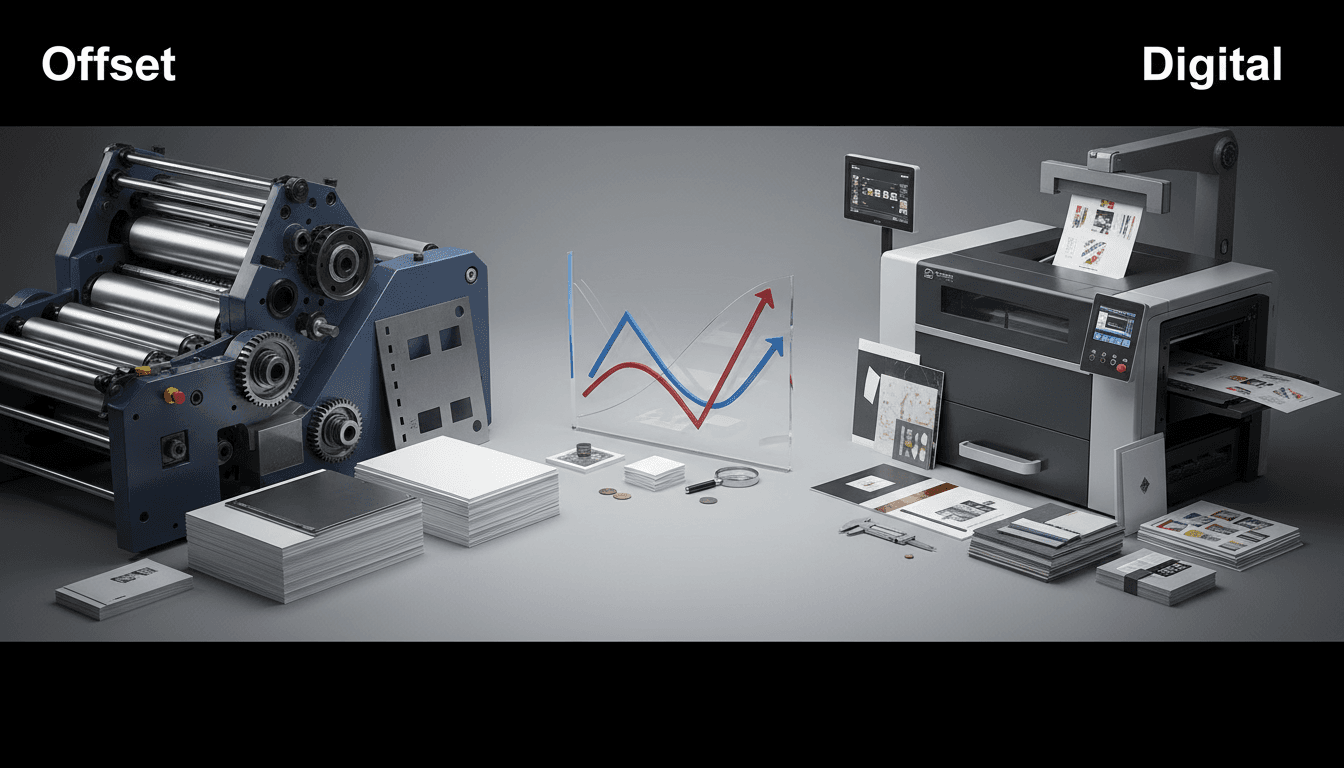
A data-driven guide to calculating true per-unit print costs, revealing how material choices and run lengths impact your 2026 packaging budget with breakeven analysis.
You've received two quotes for a 300gsm folding carton project: one for offset, one for digital. The digital quote has a lower upfront cost, but the per-unit price is higher. Which is truly more cost-effective for your 2026 launch schedule? The wrong choice here doesn't just waste budget; it locks you into production bottlenecks, material limitations, and quality inconsistencies that can derail a product launch.
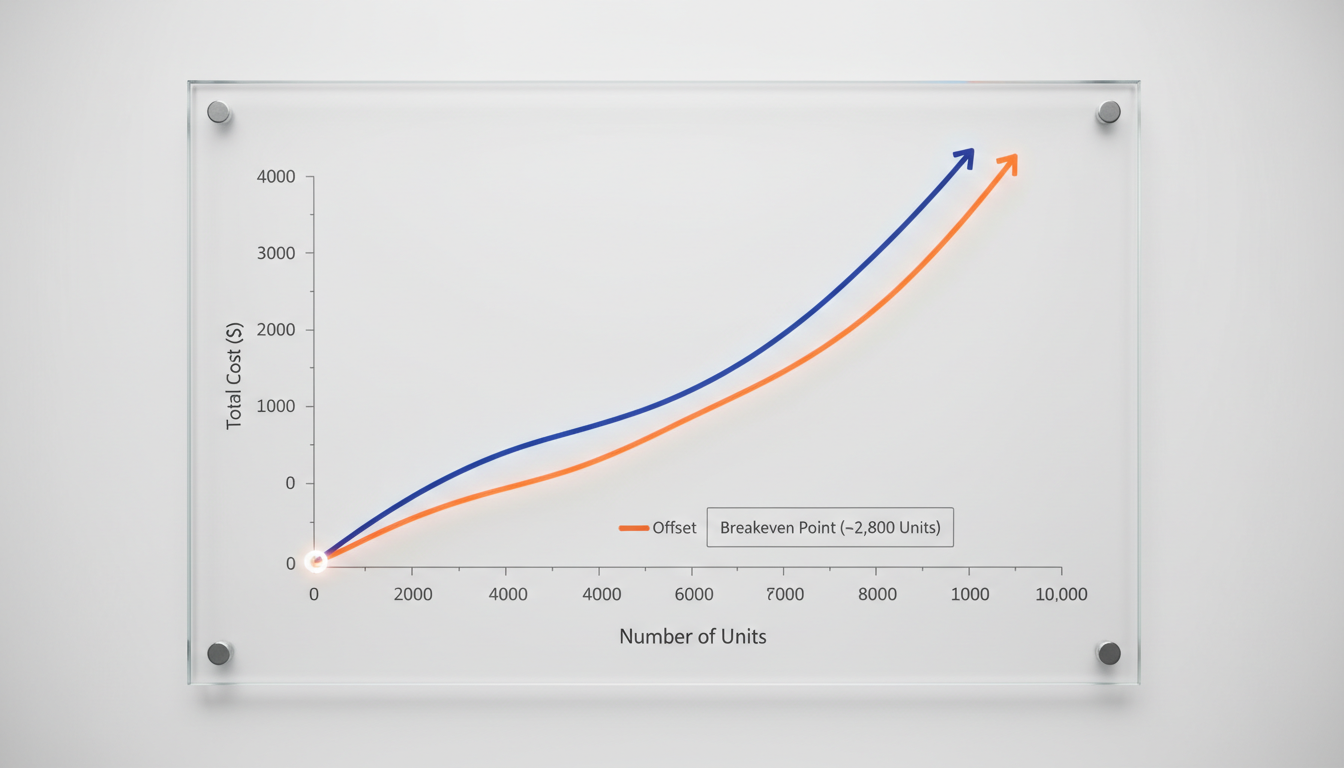
- For runs under 2,800 units, digital printing often wins on total cost, even with a higher per-unit price, due to zero plate charges.
- Specifying C1S board over C2S for cosmetic packaging can save 12-18% on material costs with no visible quality loss on the printed surface.
- FDA-compliant food packaging requires barrier coatings or BOPP lamination that add $0.03-$0.07 per unit; digital presses often cannot apply these inline.
- Cold chain labels need synthetic materials like PP or PE with permanent acrylic adhesive; test adhesion at -20°C for at least 72 hours.
- Implement G7 calibration and request ICC profiles from your printer to achieve a Delta E tolerance of <2.0, ensuring color consistency across offset and digital reprints.
The True Cost Equation: Breaking Down Offset & Digital Variables
What is the real cost per unit? Most quotes separate line items, obscuring the total. True cost combines fixed setup charges with variable run costs. For offset, fixed costs include plates and make-ready. For digital, fixed costs are near zero, but variable costs per sheet are higher.
In our experience running 6-color Heidelberg Speedmaster XL 106 presses, a common mistake we see is clients comparing only the per-unit price. A $0.12/unit offset cost looks cheaper than a $0.35/unit digital cost. But if you only need 1,000 units, the $450 in plate charges for offset makes digital the cheaper total option. You must calculate the breakeven point.
According to Smithers Pira's 2025 Global Print Market report, surveying 800+ converters across 32 countries, the average make-ready time for a complex packaging job on a new-generation offset press has dropped to 23 minutes. This reduces waste but doesn't eliminate the plate cost. Our head of prepress, with 15 years of Heidelberg experience, recommends: "Always request a detailed cost breakdown that separates plate charges (fixed) from running costs (variable). This is your first step in accurate comparison."
When Does Digital Printing Become Cost-Effective for Packaging?
Digital becomes cost-effective for short runs, rapid prototyping, and versioning. The threshold is determined by your fixed costs divided by the per-unit savings. For packaging, material compatibility often decides before cost does.
The breakeven formula is: (Offset Plate & Make-ready Cost) / (Digital Per-Unit Cost - Offset Per-Unit Cost) = Breakeven Quantity. Example: ($500 plates + $200 make-ready) / ($0.32 digital - $0.14 offset) = ~3,900 units. Below this, digital wins on cost. However, this assumes identical materials. A 2026 trend is hybrid workflows: using digital for short-run market tests followed by offset for the full production run.
Decision: Offset, Digital, or Hybrid?
- If run length < 3,000 units OR requires versioning/personalization → Choose Digital (e.g., HP Indigo 12000).
- If run length > 5,000 units OR requires exact Pantone spot colors, heavy foil stamping, or specialty coatings → Choose Offset Lithography.
- If launching a new product with uncertain demand → Choose a Hybrid Strategy: digital for initial 1-2K units, then shift to offset for reorders above 5K units.
At JinXinCai, we recently executed this hybrid model for a health supplement launch. The client used digital for 1,500 test-market boxes, then switched to our Heidelberg XL 106 for the 15,000-unit main run. This saved over $2,800 in wasted plates had the initial design failed in-market.
Material & Finish Compatibility: What Are the Trade-Offs?
Your choice of 300gsm folding carton board printing options is constrained by the press. Offset handles a vast range of substrates (80-450 gsm); digital is limited to approved, often coated, stocks. The finish defines the function.
For waterproof label material for cold chain logistics, digital presses can print on synthetic stocks, but the adhesive is the critical component. We've tested dozens: a permanent acrylic adhesive applied at 22gsm weight performs consistently at -20°C. Offset with screen-printed varnish can achieve similar water resistance. The trade-off is lead time and cost. Digital labels for cold chain can be turned in 3-5 days; offset with specialty varnish requires 10-14 days but at a 30% lower cost per unit for runs over 8,000.
| Factor | Offset Lithography | Digital (e.g., HP Indigo) |
|---|---|---|
| Material Range | Very Wide: Uncoated, C1S/C2S board, synthetics, metallic papers. | Narrow: Primarily pre-coated digital-specific stocks. |
| Spot Color (Pantone) | Excellent. Can run dedicated spot color stations for perfect matches. | Simulated via 4-color process. Can deviate from brand standard. |
| Inline Finishing | Yes. Aqueous coating, UV spot varnish can be applied inline on a 6+2 press. | Limited. Most finishing (lamination, die-cutting) is offline, adding cost/time. |
| Best for Food Packaging FDA Compliance | Yes. Can use FDA-compliant inks and apply barrier laminations (BOPP, PET) inline. | Potentially. Requires pre-laminated digital stock, which is rare and expensive. |
A common mistake we see when clients specify materials is ordering C2S (clay-coated two sides) board when only one side is printed. For a cosmetic carton printed on one side, switching to C1S board can reduce material costs by 12-18% with zero impact on the final product quality.
How to Specify Print Jobs for Optimal Quality and Cost
Clear, print-ready specifications prevent costly errors and change orders. Your spec sheet must cover material, color, finish, and compliance. Ambiguity is the enemy of your budget and timeline.
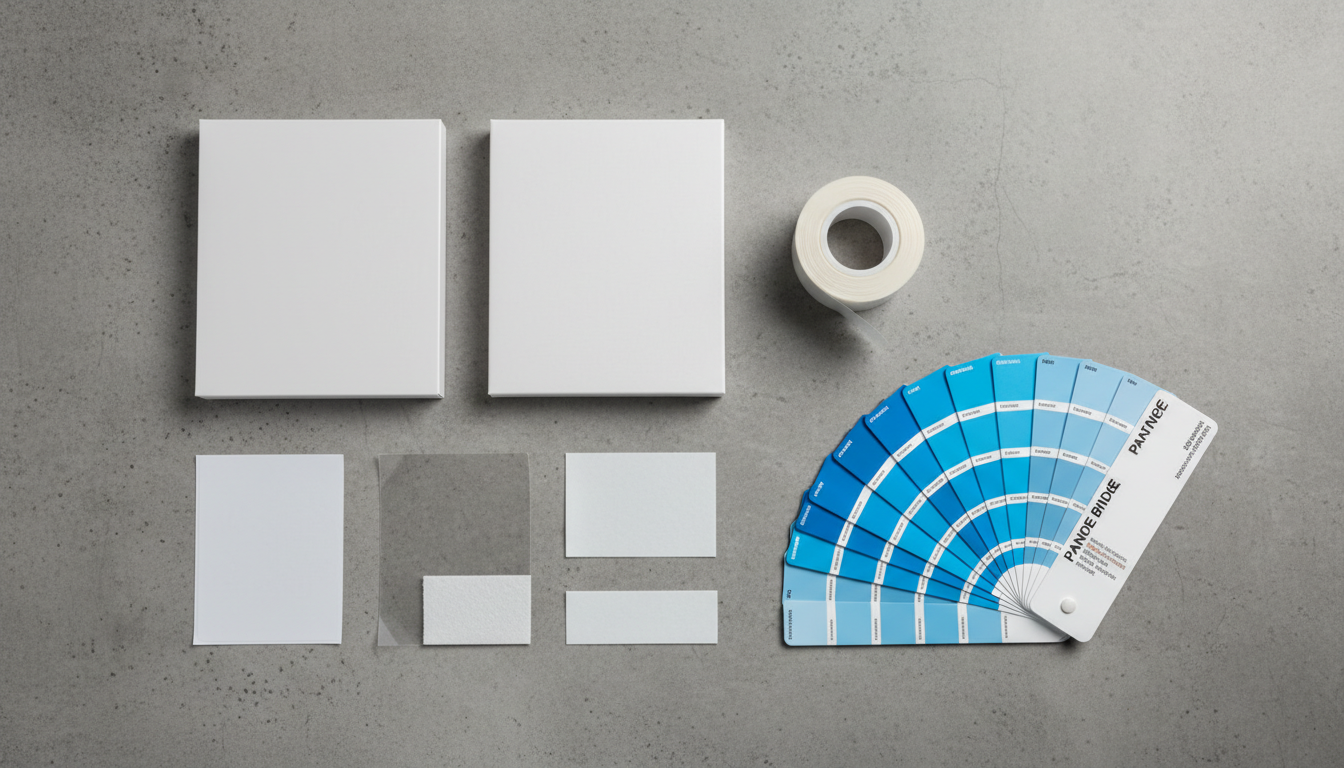
First, for color consistency: always provide Pantone codes and request a physical hard proof. At our Shenzhen facility, we run G7-calibrated proofing on every job. We then match the press sheet to that proof using a spectrophotometer, targeting a Delta E of less than 2.0. For projects that may reprint across different methods, insist on an ICC profile from your printer. As our prepress head states: "An ICC profile bridges the gap between digital RGB, offset CMYK, and the actual press, making cross-platform color possible."
Second, understand food packaging FDA compliance label requirements. This isn't just about the ink. FDA 21 CFR Part 175 covers adhesives, Part 176 covers paperboard. Compliance requires documentation from your material suppliers. We maintain certified supply chains for these projects, but you must specify the need upfront. A non-compliant print run is scrap.
Decision Framework: A 5-Step Checklist for Brand Managers
Use this framework for every print project in 2026. It moves from strategy to specification, forcing quantitative decisions. This prevents subjective choices from inflating costs.
- Define the Run Strategy: Is this a one-time run, or will there be repeat orders over 12+ months? For repeats, offset ensures color consistency. For one-offs, digital offers flexibility.
- Calculate the Breakeven: Use the formula provided. Get detailed quotes with all fixed and variable costs separated. The threshold often lies between 2,500 and 4,000 units.
- Audit Material & Finish Needs: Must it be waterproof? FDA-compliant? Include foil stamping? Check the compatibility table in this article. If digital can't handle the required finish, offset is your only choice.
- Specify for Color Accuracy: Provide Pantone codes. Require G7 calibration and a physical proof. Discuss and approve an ICC profile if cross-platform printing is possible.
- Validate the Supply Chain: Ask for certifications (ISO 9001, ISO 14001, like ours from SGS International). For regulated industries, demand evidence of compliant material sourcing. Visit the facility if possible.
This framework turns a complex procurement decision into a series of manageable, evidence-based steps. We've run over 500 packaging programs, and the most common issue is skipping step #3, leading to last-minute, expensive material changes.
Get a detailed, line-item quote for your next project to accurately calculate your breakeven point and optimal print method.
Get a Free Quote →Case Study: Reducing Per-Unit Costs for a Seasonal Product Launch
This real-world scenario shows how strategic print management impacts the bottom line. A marketing agency needed packaging for 15+ boutique brand clients, each with low-volume, high-design seasonal products (2,000-5,000 units).
Industry: Marketing Agencies / Boutique CPG.
Problem: The agency needed to fulfill orders without revealing their manufacturing source (blind shipping) and manage vastly different projects efficiently. Each client had unique material and finish requests, from embossed cosmetic cartons to simple folded boxes. Their existing model using local digital printers was exceeding budget by 40%.
Our Solution: We implemented a white-label program. The agency provided designs, and we handled all technical specs, sourcing FDA-compliant materials where needed, and production. We gang-ran compatible jobs on our Heidelberg XL 106—for example, running several different 300gsm C1S cosmetic carton jobs simultaneously on a large sheet. This dramatically reduced per-unit costs by sharing plate and make-ready charges across clients. All shipping used the agency's branding, and quality reports were generated under their identity.
Outcome with Metrics: The agency scaled its print revenue by 40% without capital investment. By leveraging our offset capabilities for gang runs, they reduced the average cost per unit by 22% for jobs in the 3,000-5,000 unit range. Their client retention rate averaged 92% over two years, attributable to reliable quality and cost savings passed on to their brands.
Reduction in average per-unit cost achieved through strategic gang-run offset printing.
This case highlights a key 2026 trend: procurement efficiency through partnership. The agency didn't just buy print; they leveraged our manufacturing flexibility and ISO 9001-certified processes as a strategic extension of their service.
Action Items for Q1-Q2 2026
Forward-looking strategy requires immediate action. Here are concrete steps to implement this quarter.
- Audit Past Projects: Review 3-5 recent print jobs. Calculate the true total cost (setup + run) and identify if the wrong print method was used. This establishes your baseline.
- Create a Specification Template: Build a checklist based on Section 4 of this guide. Mandate its use for all new print requests to eliminate ambiguity.
- Request ICC Profiles: From your current print partners, request the ICC profiles for their standard offset and digital presses. Use these to soft-proof future designs for better accuracy.
- Test Cold Chain Materials: If you ship temperature-sensitive goods, order samples of synthetic label materials (PE, PP) and conduct a 72-hour adhesion test in a -20°C environment.
- Evaluate Hybrid Feasibility: Identify one upcoming product launch suitable for a hybrid digital-to-offset strategy. Model the cost savings of a 2,000-unit digital test run versus a full offset commitment.
The core decision between offset vs digital printing cost per unit comparison is not static. It's a dynamic calculation shaped by volume, material, and time. By applying the frameworks and data here, you shift from reactive purchasing to proactive print management. This is how you control costs and ensure quality in 2026 and beyond.
Your next step is to apply the breakeven formula to an active project. Contact our team for a detailed, transparent quote that separates all cost components, so you can make the optimal choice with confidence.
Frequently Asked Questions
How does print run length affect the breakeven point between offset and digital?
The breakeven point is where the total cost of both methods is equal. It's calculated as: (Offset Plate & Make-ready Cost) / (Digital Per-Unit Cost - Offset Per-Unit Cost). For example, with $700 in offset setup and a $0.18 per-unit price difference, the breakeven is ~3,900 units. Below this quantity, digital is typically cheaper in total cost; above it, offset wins.
What should I specify when ordering to ensure color consistency across print methods?
First, provide exact Pantone spot color codes. Second, require your printer to use G7 calibration for proofing and production. Third, request and use the printer's specific ICC profile for their offset and digital presses when creating your artwork. Finally, always approve a physical hard proof under standard D50 lighting. This process can achieve a Delta E color tolerance of less than 2.0.
How do plate charges and make-ready costs factor into the total cost per unit?
Plate charges are a fixed, upfront cost for offset printing, typically ranging from $100-$600 per color plate depending on size. Make-ready costs cover the time and material to set up the press, often $200-$500. These costs are amortized over the total print run. On a 1,000-unit job, $450 in plates adds $0.45 to each unit. On a 10,000-unit job, it adds only $0.045, making offset far more economical at higher volumes.
What are the quality trade-offs with digital printing on specialty substrates?
Digital presses like the HP Indigo are limited to pre-approved, often coated, substrates. While quality on these is excellent, you may trade off the ability to use uncoated, textured, or heavier board stocks common in luxury packaging. Additionally, specialty finishes like foil stamping, embossing, or high-gloss UV coating cannot be applied inline on digital presses and must be done as a separate, offline process, increasing cost and lead time.