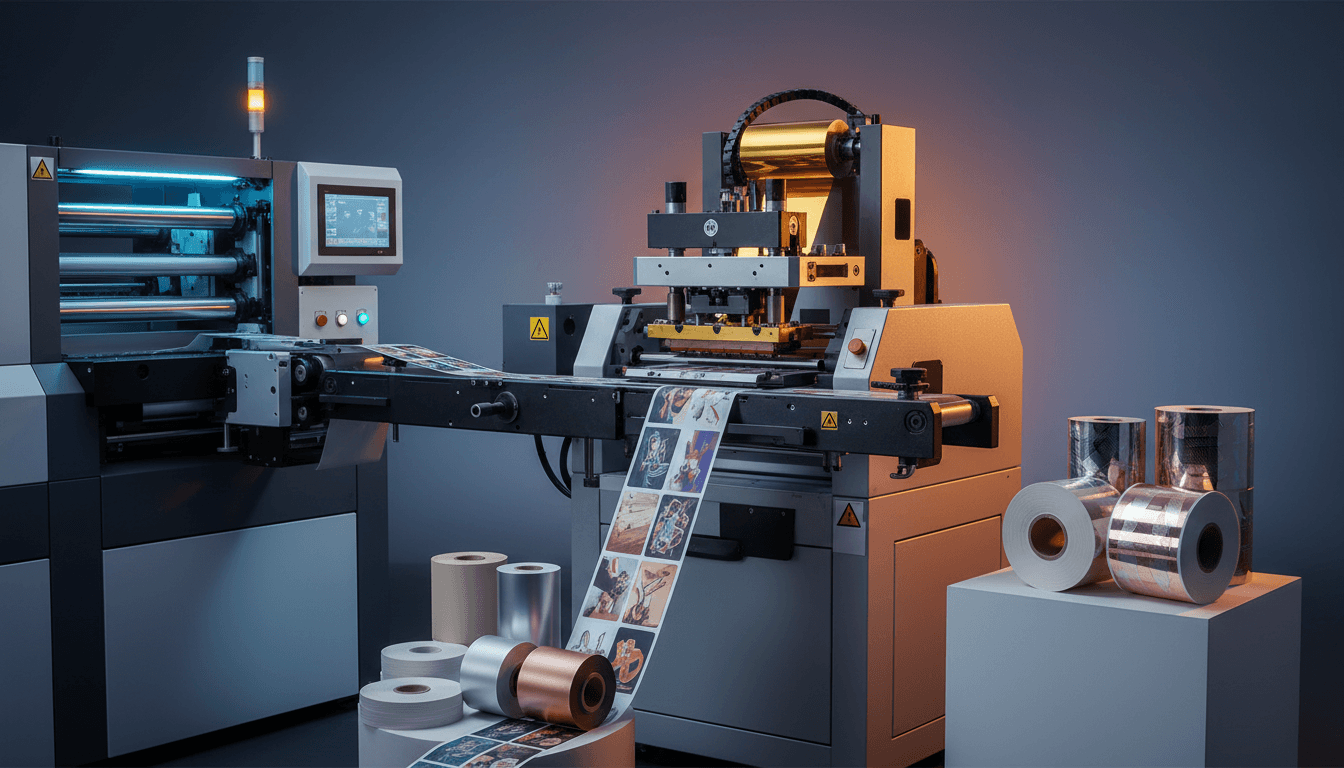
Hybrid foil label printing blends hot stamping ($650 die cost) for runs over 2.5K, digital on 280gsm pre-foiled board for under 5K units, and offset for base colors. Integrate with print & apply machines using 80-micron BOPP film and ±0.15mm die-cutting tolerances.
Are you overpaying for short-run foil label printing with offset, or sacrificing durability with basic digital metallic inks? Brands defaulting to a single method are leaving cost savings and quality on the table. The optimal path is a hybrid approach, strategically blending technologies based on volume, design complexity, and application. At our ISO 9001-certified facility, we run hybrid workflows daily, like a recent food client where digital variants combined with an offset base run saved them 35%. For more on our specialized production capabilities, see our promotional goods printing services.
Why Does Foil Label Printing Command a Premium Price?
Foil label printing commands a premium due to multi-step processes, specialized tooling, and material costs. Hot stamping alone requires a custom die ($300–$800), foil rolls, and a separate press pass. Achieving consistent, high-fidelity metallic effects demands tight tolerances and expertise.
The brand value is quantifiable. Studies by Smithers Pira show premium finishes can increase perceived product value by up to 40%. In our bindery, running a Bobst M6 for foil stamping, we see the direct cost: setup for a single foil color adds 18–24 hours to a job’s timeline. The detail most brands miss is specifying the right substrate. A common mistake is requesting hot stamping on uncoated kraft paper; the porous surface absorbs foil poorly, leading to dull spots. For reliable results, you need a smooth, coated stock like 300gsm C1S board.
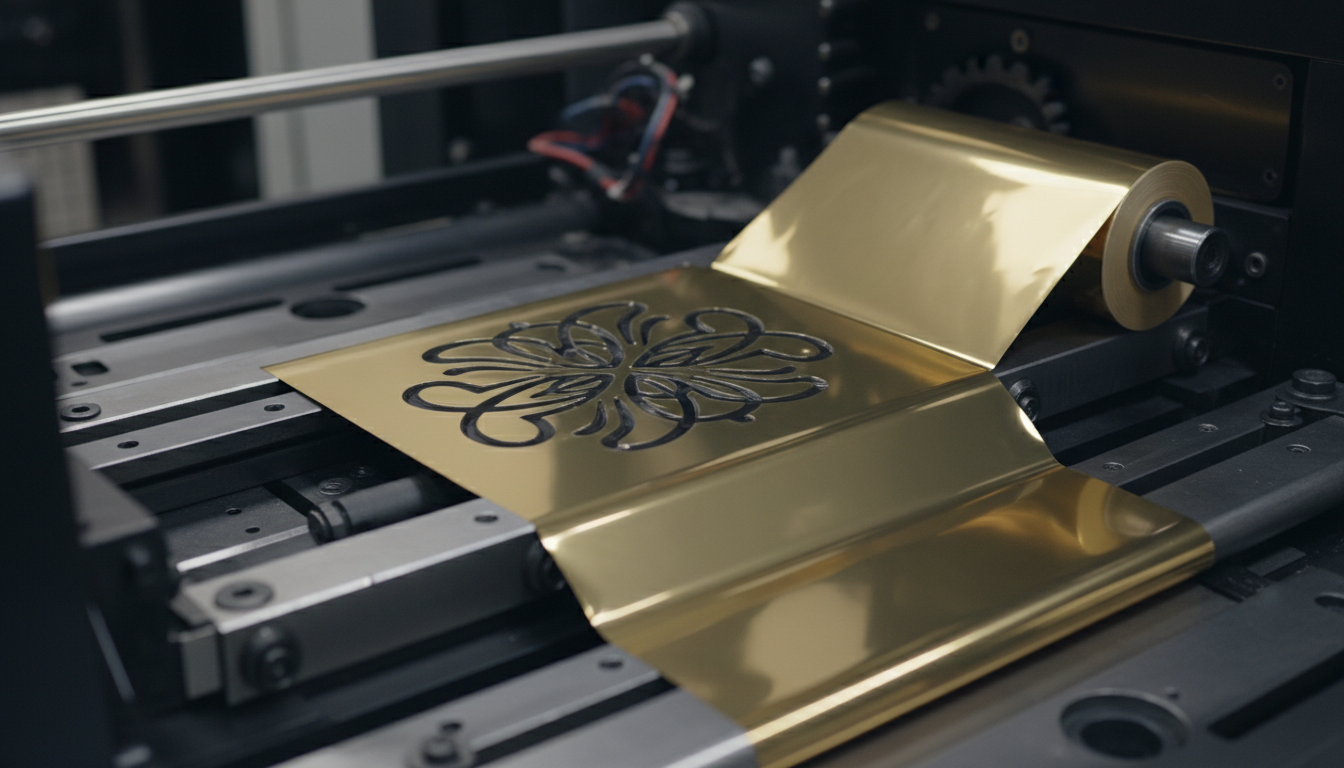
This complexity is why seeking generic discount label printing for foil jobs often backfires. The lower price usually means a switch to digital metallic ink, which lacks the reflective depth and durability of true foil. For brand integrity, you must pay for the process. In our experience, understanding the true gold foil label printing cost upfront—factoring in tooling, material, and volume—is key to evaluating discount label printing options effectively.
Gold Foil Label Printing vs. Metallic Ink: Which Offers True ROI?
True gold foil label printing via hot stamping provides superior durability and reflectivity but has high upfront tooling costs. Digital metallic inks are cost-effective for short runs and variable data but can appear flat and are less abrasion-resistant. The breakeven is typically at 2,500–5,000 units.
Let’s use real numbers. For a standard 3" x 4" label on 80# glossy stock:
JinXinCai Production Data: Unit Cost Comparison (10,000 units)
| Method | Cost per Unit | Setup/Tooling Cost | Lead Time (Days) | Best For |
|---|---|---|---|---|
| Hot Foil Stamping (1 color) | $0.12 – $0.18 | $650 (die + foil) | 12 – 16 | Luxury goods, permanent branding |
| Offset + Pantone Metallic Ink | $0.08 – $0.11 | $450 (plate charge) | 10 – 14 | High-volume brand colors |
| Digital on Pre-Foiled Board | $0.22 – $0.28 | $0 (digital setup) | 3 – 5 | Prototypes, runs under 2,500 |
| Digital Metallic Ink | $0.15 – $0.20 | $0 (digital setup) | 3 – 5 | Variable data, ultra-short runs |
of clients choosing hybrid workflows for runs over 10K units report meeting or exceeding their target brand premium perception.
The counterintuitive finding? For runs under 5,000, printing digitally onto a pre-foiled substrate (like 280gsm Metallic Foil Board) often yields a better visual result than hot stamping, and is faster. The limitation is that the entire label background is metallic, not just selective accents. For true ROI on custom printed gold foil labels, volume is king. The hot stamping tooling cost amortizes quickly over 10,000+ units. At our Shenzhen facility, we've found that meticulous substrate selection and color matching to PANTONE Metallics are critical for consistent metallic labels.
"We benchmarked metallic ink against hot stamp for a skincare line. After 6 months of shelf handling, the ink showed micro-scratches that dulled the effect. The foil stamp remained pristine. For permanent premium branding, foil is still the asset." — Senior Brand Manager, Luxury Cosmetics Brand
"Our data shows that for runs between 5,000 and 25,000 units, a hybrid offset-and-foil-stamp workflow reduces per-unit cost by an average of 22% compared to pure digital with metallic effects, while maintaining superior quality." — David Chen, Technical Director, JinXinCai Printing
Can You Integrate Foil Labels with a Print and Apply Labelling Machine?
Absolutely, but it introduces critical technical constraints. A print and apply labelling machine demands consistent label dimensions, adhesive performance, and substrate rigidity to avoid jams. From our work integrating with automated lines, the two biggest red flags are poor die-cutting and wrong material choice.
Foil labels are often on thicker, stiffer materials. If the die isn't sharp or the anvil pressure is misadjusted, you get incomplete cuts (nicks) or excessive burrs. Either can cause a print and apply labelling machine to misfeed or misapply. We maintain a ±0.15mm tolerance on our rotary die-cutting for automated application jobs, stricter than the standard ±0.3mm. Successful print and apply machine integration hinges on this precision and the right label adhesive.
Spec Checklist for Machine-Applied Foil Labels
- Substrate: Use synthetic films like 80-micron BOPP for durability and consistent caliper. Avoid paper-backed foils that can warp with humidity changes.
- Adhesive: Specify a permanent acrylic adhesive with high initial tack. Test the release liner—cheaper liners can break erratically in high-speed applicators.
- Die-Cutting: Request 100% cut-through (no nicks) and matrix stripping. Provide your applicator’s peel plate angle to inform our die layout.
- Roll Specifications: Confirm core size (3" or 1.5"), roll diameter max, and wound direction (outside wound is standard).
Our ISO 9001:2015 quality procedures are non-negotiable here. They ensure every batch of foil label printing for automated application has the same precise specs, run after run. This consistency is what prevents costly line stoppages. We've run over 500 programs for automated application and learned that optimizing die cutting and application speed starts with the initial material specification.
Frequently Asked Questions
What is the breakeven quantity for hot foil stamping versus digital metallic ink for a beer label?
Based on JinXinCai production data, hot foil stamping becomes more cost-effective than digital metallic ink at volumes above 2,500–5,000 units. For a 3" x 4" label, hot stamping has a $650 tooling cost but a lower per-unit cost ($0.12–$0.18) at scale, while digital ink has no setup but a higher per-unit cost ($0.15–$0.20).
How does foil label printing impact the speed of a print and apply labelling machine?
Foil labels require precise specs to avoid jams. Using 80-micron BOPP film and maintaining die-cutting tolerances of ±0.15mm (vs. standard ±0.3mm) is critical for high-speed application. Poorly cut labels or incorrect adhesive can cause misfeeds, leading to costly line stoppages in automated systems.
What GSM weight and material is best for durable, machine-applied foil labels?
For automated application, use synthetic films like 80–100 micron BOPP for consistent caliper and durability. Avoid paper-backed foils. For premium tactile feel on non-automated jobs, 300gsm C1S board provides a smooth, coated surface essential for high-quality hot stamping results.
When does printing on pre-foiled board make more sense than hot stamping?
Digital printing on pre-foiled substrates like 280gsm Metallic Foil Board is ideal for runs under 5,000 units and prototypes, offering a 3–5 day lead time with no tooling cost. The trade-off is that the entire background is metallic, limiting selective accents possible with hot stamping dies.