The FDA's new traceability rule demands specific data on packaging by 2026. This guide details material selection, print technology trade-offs, and cost-effective compliance strategies for brand managers.
If your food packaging lacks machine-readable lot codes or uses inks that smudge in cold storage, you risk regulatory action and costly product recalls starting in 2026. The FDA's Food Traceability Final Rule (FSMA 204) moves beyond simple ingredient lists, mandating that packaging itself becomes a critical data carrier. This isn't just a labeling update; it's a fundamental shift in how you specify materials, select print methods, and manage your supply chain. Missteps here lead to non-compliant inventory, rejected shipments, and significant financial penalties.
- FSMA 204 requires both human- and machine-readable Key Data Elements (KDEs) like lot codes and GTINs on packaging for specific foods by January 2026.
- Material durability is non-negotiable: labels must withstand -20°C to 40°C temperature cycles and 95% RH without adhesive failure or ink smudging.
- The breakeven for digital vs. flexo printing for variable traceability data typically falls between 3,500 and 5,000 units, depending on label complexity.
- Verifying a printer's FDA compliance requires documented evidence of food-grade material sourcing, ink certifications, and 21 CFR Part 11-compliant data handling.
- Start your packaging specification review now; lead times for compliant material testing and print process validation can exceed 12 weeks.
What the FDA's New Food Traceability Rule Means for Packaging
The FDA Food Traceability Rule (FSMA 204) transforms packaging from a passive container to an active data node in the supply chain. By January 20, 2026, foods on the Food Traceability List (FTL)—including fresh produce, cheeses, and ready-to-eat salads—must have specific Key Data Elements (KDEs) recorded and linked to packaging at Critical Tracking Events (CTEs). The most immediate impact for brand managers is that these KDEs, like the Lot Code and GTIN, must be physically present on the package in both human-readable and machine-readable forms (typically a 2D barcode). This is not a suggestion for best practice; it's a enforceable requirement for record keeping and package marking.
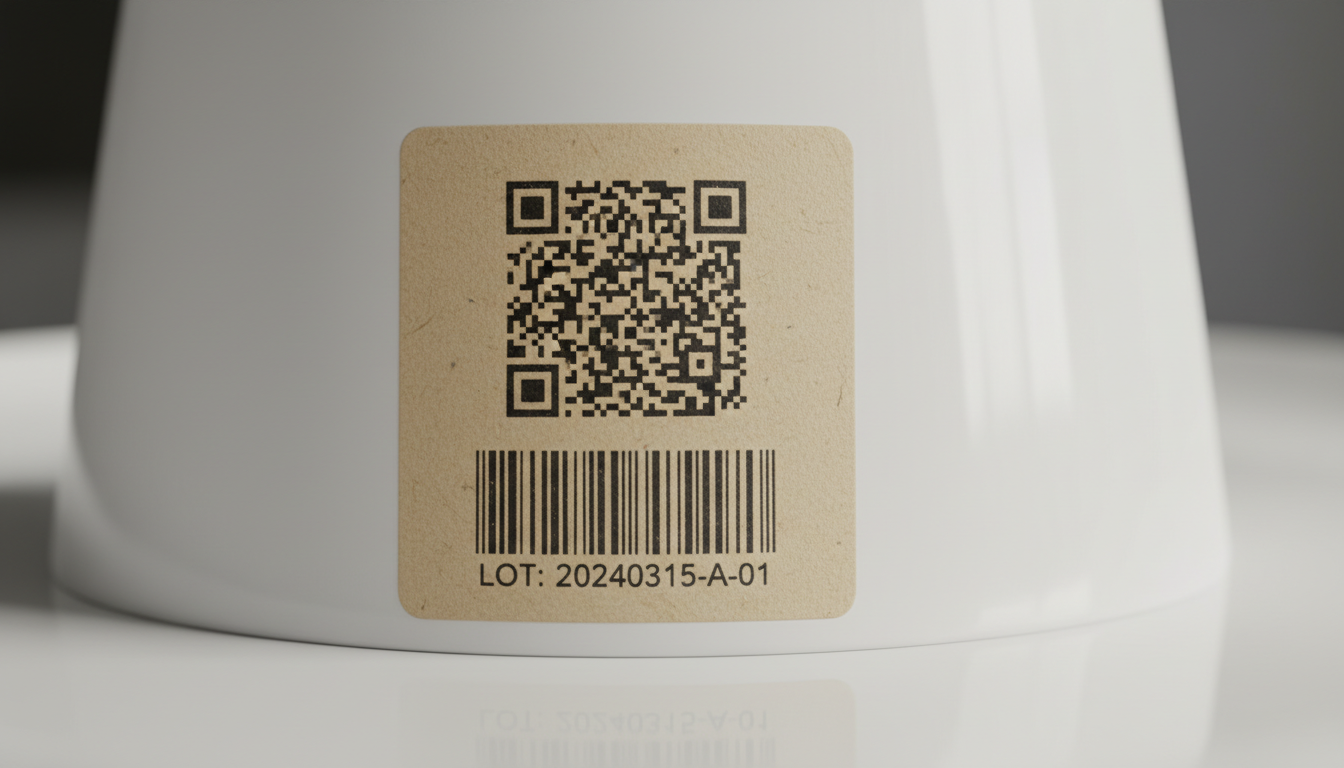
In our experience running packaging for retail food chains, the most common oversight is treating this as a simple "add a barcode" project. It's not. The rule mandates data continuity. The lot code printed on your specialty material label in Shenzhen must be the exact same lot code digitally recorded when that case is shipped from your DC in Chicago. Any disconnect between the physical mark and the digital record creates a compliance failure. According to the FDA's own economic analysis, the average cost of a Class I recall for a mid-sized food company exceeds $10M when accounting for lost sales, retrieval logistics, and brand damage—a cost that compliant traceability aims to prevent.
Key Data Elements: What Must Be on Your Package or Label?
Your packaging must clearly display specific KDEs to comply with FDA traceability guidelines. The non-negotiable elements are the Lot Code (or other unique identifier) and the GTIN (Global Trade Item Number). The FDA explicitly requires these to be "easily discernible" and linked to electronic records. In practice, "easily discernible" means the human-readable text must meet minimum size and contrast standards, while the machine-readable element (a 2D DataMatrix or QR code) must achieve a minimum grade of "C" per ISO/IEC 15415 scannability standards under realistic supply chain conditions.
A common mistake we see is clients specifying barcodes designed for ideal retail scanning, not harsh logistics environments. A barcode that scans in a warehouse at 20°C may become unreadable after condensation forms on a package moved from cold storage to a humid loading dock. Our pre-press team, led by a 15-year veteran of Heidelberg systems, now builds in additional quiet zones and uses higher contrast ratios for all traceability marks. We recommend a minimum X-dimension (the narrowest bar/space) of 20 mils for codes applied to flexible packaging, compared to the 13-mil standard for retail shelf labels, to compensate for potential distortion.
Human-Readable vs. Machine-Readable: A Dual Requirement
You cannot rely on a scannable code alone. The FDA mandates a human-readable equivalent as a fail-safe. This text must be permanent and legible. We've tested numerous ink and substrate combinations; for cold chain applications, UV-cured inks on synthetic BOPP or PE materials consistently outperform water-based inks on paper, which can swell and blur. The human-readable lot code should be printed in a sans-serif font no smaller than 8pt and have a minimum 70% contrast difference from the background substrate.
"The biggest risk isn't the printer missing a digit," says Martin Chen, our Head of Quality Assurance. "It's variable data systems failing to synchronize. We've implemented 21 CFR Part 11-compliant software that cryptographically hashes each print file against the production order, creating an immutable audit trail from data intake to pallet label."
Packaging Material Selection for Compliance & Durability
Selecting materials that meet FDA food traceability guidelines is a balance of regulatory safety and physical endurance. The substrate must be FDA-compliant for food contact (per 21 CFR 174-178), and the printed traceability mark must survive the entire product journey. For cold chain packaging, this means withstanding extreme temperature cycling, condensation, and abrasion without the adhesive failing (label peeling) or the ink migrating (smudging into illegibility).

For frozen goods, we specify our 80-micron BOPP (biaxially oriented polypropylene) synthetic material as a baseline. It's inherently waterproof, tear-resistant, and maintains dimensional stability from -20°C to 40°C. The adhesive is a permanent acrylic formulated for low-surface-energy plastics like HDPE and PP, with a minimum application temperature of 5°C. A critical red flag is a supplier who cannot provide a Technical Data Sheet (TDS) for the adhesive detailing its glass transition temperature (Tg)—this is the point where it becomes brittle and can fail.
For dry goods or cartons, a food-safe C1S Coated Folding Carton Board (300-400 gsm) is often suitable. However, if the carton will experience any humidity—like in a refrigerated produce section—you must specify a varnish or laminate that protects the printed code. A water-based coating may reactivate under humidity, causing ink offset. We use a low-migration UV coating cured with LED lamps, which creates a durable, non-yellowing barrier without VOCs.
Print Technology Comparison: Which Method Best Suits Traceability Needs?
Your choice of print technology directly impacts data accuracy, durability, and cost-per-unit for traceable packaging. The core decision hinges on whether your traceability data (lot codes, dates) is variable (changes every batch) or static. For static data, traditional offset or flexography is ideal. For variable data, digital or hybrid solutions are necessary.
| Factor | Digital Printing (e.g., HP Indigo) | Flexographic Printing | Offset Lithography |
|---|---|---|---|
| Best For | Variable data, short runs (<5,000 units), rapid version changes | Long runs (>50,000 units), flexible packaging, consistent color | High-quality cartons, mid-to-long runs, superior color fidelity |
| Variable Data Capability | Native—every label can be unique with no plate change | Requires expensive rotary die or sleeve changes; not cost-effective for true variability | Not feasible for variable data; plates are fixed |
| Upfront Cost (Plate/Digital Setup) | Low to moderate ($150-$400 digital file setup) | High ($800-$2,000 for engraved ceramic anilox rolls & plates) | Moderate ($450-$800 for aluminum plates) |
| Cost-Per-Unit (Example: 3"x5" label) | $0.22 - $0.35 (economies of scale limited) | $0.07 - $0.12 (becomes very efficient at high volume) | $0.10 - $0.18 (efficient for cartons in 10k+ runs) |
| Durability of Print | Good with UV inks; can be susceptible to abrasion on some synthetics | Excellent; thick ink layers and durable UV/water-based formulations | Excellent when combined with protective coating; ink is bonded to substrate |
| Lead Time for Production | 5-10 business days (no physical plates) | 14-21 business days (includes plate/roll fabrication) | 10-14 business days (includes plate making) |
For a job requiring unique sequential barcodes on each of 10,000 labels, digital printing is the only practical choice. However, if you need 500,000 labels with the same static barcode and only the lot code changes weekly, a hybrid approach works: print the static design via flexo, then use a digital overprint unit (like a Domino inkjet head) to add the variable lot code. At JinXinCai, we've integrated this hybrid line to serve clients in the food and beverage sector, achieving the durability of flexo with the flexibility of digital for variable traceability data.
A Decision Framework: Balancing Compliance, Cost & MOQs
Choosing the right compliance path requires weighing regulatory needs against production economics. Use this framework to guide your specification.
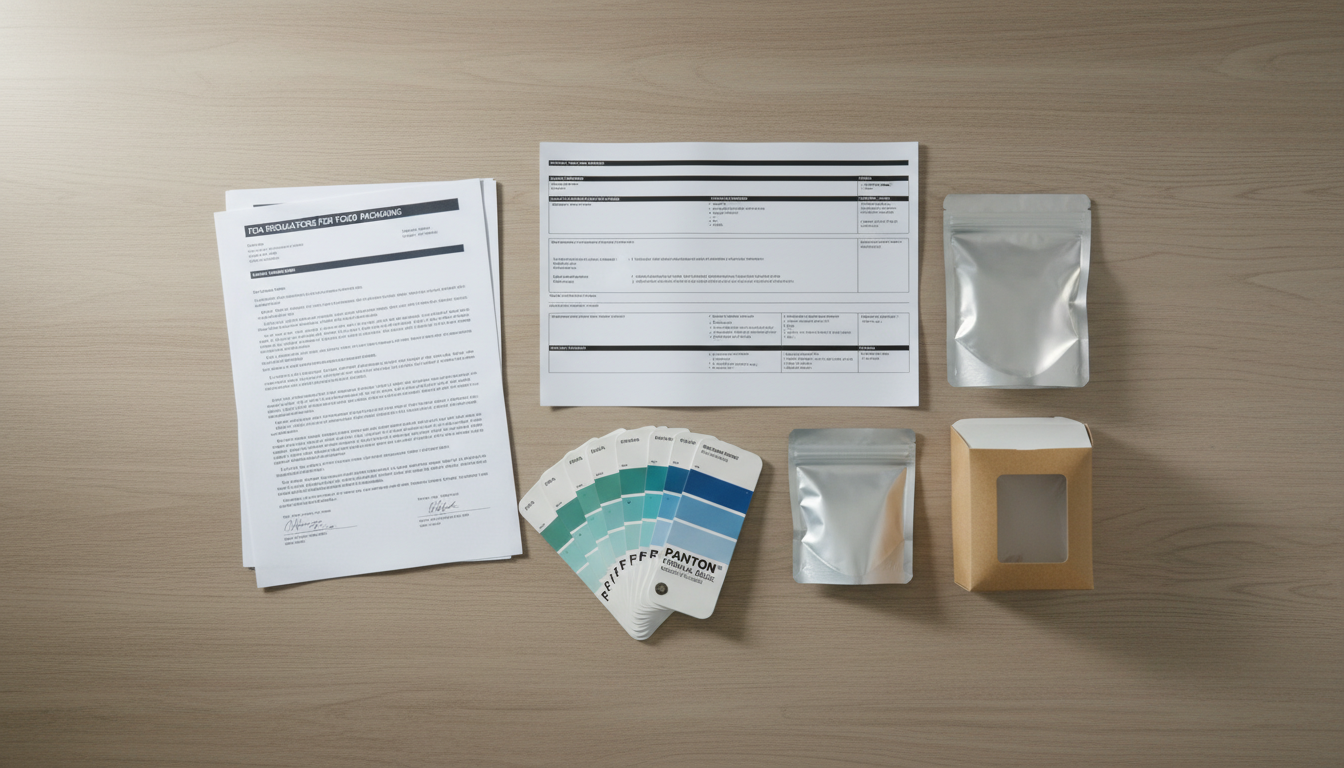
Decision: Selecting Your Print & Material Strategy for FSMA 204
- Is your traceability data (Lot Code/GTIN) variable per unit or per batch? → If per unit (unique serialization), you must use digital printing. If per batch, proceed.
- What is your annual volume for this SKU? → If under 5,000 units/year, digital is likely most cost-effective. If 5,000-50,000 units, analyze the breakeven. If over 50,000 units, flexo or offset will have a lower cost-per-unit.
- What is the product's storage and distribution environment? → If frozen/wet/cold chain, you must select a synthetic substrate (BOPP/PE) and permanent adhesive with a documented Tg. If dry/ambient, paper or C1S board may suffice.
- What is your acceptable minimum order quantity for FDA compliant labels? → Digital MOQs can be as low as 500 units. For flexo, the MOQ is typically 10,000+ units to amortize plate costs. Your MOQ must align with your batch size to avoid obsolete, non-compliant inventory.
Trade-Off Analysis: Digital vs. Flexo Breakeven
Let's quantify the decision. Assume a 4"x6" prime label for a refrigerated product.
Digital: Setup: $300. Cost/unit: $0.30.
Flexo: Plate/Cylinder Cost: $1,500. Cost/unit: $0.09.
The breakeven formula is: (Flexo Setup Cost - Digital Setup Cost) / (Digital Cost/Unit - Flexo Cost/Unit) = Quantity.
($1,500 - $300) / ($0.30 - $0.09) = $1,200 / $0.21 = ~5,714 units.
If your batch size is below 5,714, digital is cheaper. Above that, flexo saves money. This doesn't include the cost of holding inventory—if you need smaller, more frequent batches to align with traceability lot sizes, digital's flexibility may justify a higher per-unit cost.