
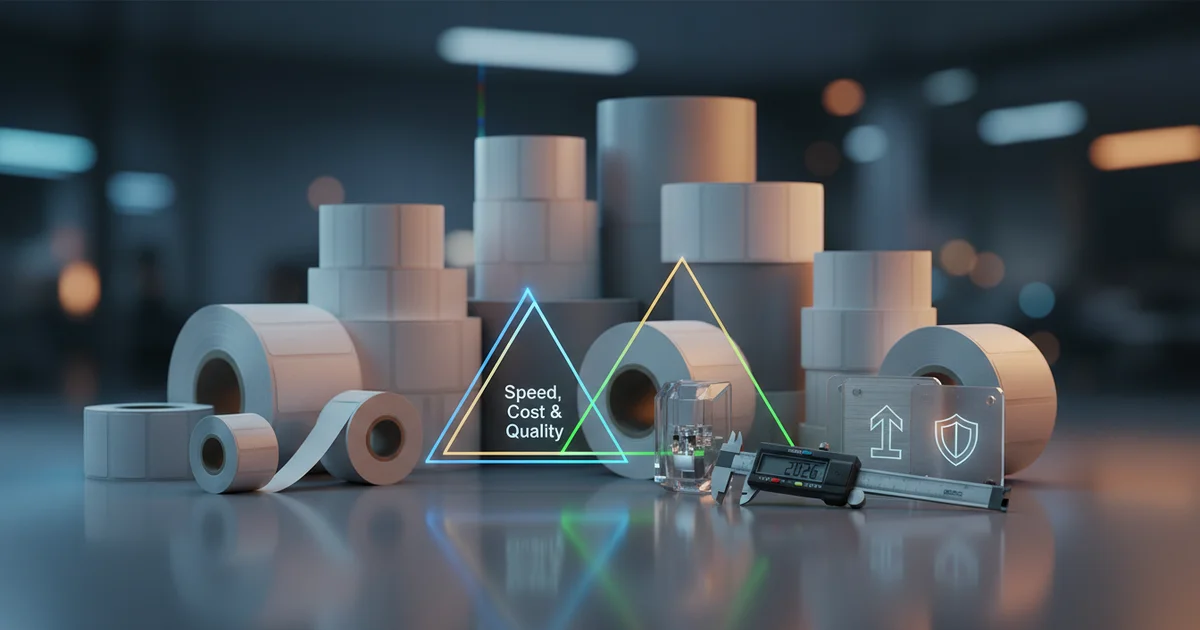
Fast label printing: Digital (HP Indigo) delivers in 3-5 days for under 5,000 units. Flexographic (6-Color Rotary Press) requires 10-14 days for plates but is faster per unit over 10,000. The breakeven is 4k-7k labels. Streamline with digital proofs and material specs like 2-mil BOPP.
How do you secure a reliable supply of printed custom labels without derailing your product launch timeline? The answer lies in selecting the right production partner and process. True fast label printing is a function of total lead time, not just press speed. This guide provides a decision framework to evaluate commercial label printing companies and choose the optimal process for your 2026 projects.
The Business Impact of Fast Label Printing
Fast label printing directly impacts cash flow, market agility, and operational efficiency. A one-week acceleration in label production can compress a new product launch cycle by 15-20%, allowing faster revenue realization and reducing inventory carrying costs for time-sensitive campaigns.
In our experience working with consumer brands, the hidden cost isn't the label itself—it's the delayed market entry. For fast label printing applications, this is especially relevant. For a product with a $50,000 weekly sales forecast, a two-week label delay represents $100,000 in deferred revenue. Furthermore, custom label printing companies that excel in speed often have streamlined workflows that reduce administrative overhead. A common mistake is focusing solely on unit cost. The real metric is total cost of ownership, which includes the financial impact of time. A thorough custom printed labels cost analysis must account for these opportunity costs.
"We've seen clients save 22% on total project cost by aligning label production speed with their just-in-time assembly schedule, eliminating warehousing for finished labels." — Head of Operations, Retail Packaging Division
How Do Commercial Label Printing Companies Ensure Speed?
Leading commercial label printing companies ensure speed through integrated digital workflows, standardized material inventories, and pre-press automation. The key is reducing non-printing time, which often constitutes 60-70% of the quoted lead time.
When evaluating partners, ask about their proofing cycle. For fast label printing applications, this is especially relevant. Companies using remote, soft-proof PDF approval with G7 calibration can shave 24-48 hours off the schedule compared to those requiring physical hard-copy proofs. Another critical factor is material stocking. A partner that keeps popular face stocks (like 60# semi-gloss or 2-mil BOPP) and adhesive liners in continuous inventory can start production immediately. From our facility data, our pre-press team's use of automated imposition software for our High-Speed 6-Color Rotary Label Press reduces makeready time by 40% compared to manual setup.
of total lead time for a typical label order is consumed by pre-press (proofing, plating) and post-press (finishing, inspection) processes, not the actual print run.
The detail that makes the difference? For fast label printing applications, this is especially relevant. Ask about their shift structure. A facility running 24/5 with dedicated changeover crews between shifts can turn around urgent jobs 50% faster than one operating standard business hours.
Digital vs. Flexographic: The Turnaround Time Trade-Off
This is the core strategic decision for fast label printing. The choice isn't about quality — both can achieve excellent results — but about the intersection of quantity, complexity, and time.
Production Data: Total Lead Time Comparison
| Process | Optimal Quantity Range | Typical Total Lead Time | Primary Time Driver | Cost per 1,000 Labels (Example) |
|---|---|---|---|---|
| Digital (HP Indigo) | 1 - 5,000 | 3-5 business days | File prep & proof approval | $85 - $120 |
| Flexographic (6-Color Rotary) | 5,000 - 100,000+ | 10-14 business days | Plate engraving & makeready | $25 - $45 |
| Hybrid Approach | Urgent 5,000 + reorder | 5 days (digital) + 12 days (flexo) | Parallel workflow management | $95 (digital) + $30 (flexo) |
| Ultra-Short Run Digital (Epson SurePress) | 1 - 1,000 | 2-3 business days | RIP processing & setup | $150 - $200 |
Digital eliminates plate-making, offering near-instantaneous changeovers. For fast label printing applications, this is especially relevant. It's unbeatable for ultra-fast, short-run custom printed labels and stickers with variable data. Flexographic, using equipment like our High-Speed 6-Color Rotary Label Press, has a longer initial setup but then produces labels at speeds exceeding 200 feet per minute. The breakeven point for total cost and effective speed typically falls between 4,000 and 7,000 labels, depending on color count.
Decision: Digital or Flexographic for Speed?
- If your need is < 5,000 labels and under 7 business days → Choose digital printing.
- If your need is > 10,000 labels and you have 10+ days → Choose flexographic for lower unit cost.
- If you need 5,000 now and 50,000 later → Use digital for the launch batch, then switch to flexo for the replenishment order, using the same approved color profile.
A common specification mistake is ordering 8,000 labels digitally because it's "fast," paying a 300% unit premium when a 12-day flexo run would have sufficed and saved thousands. For fast label printing applications, this is especially relevant. Understanding custom label printing minimum quantities for each process is key to this cost analysis.
How to Order Printed Custom Labels for the Fastest Turnaround
To order printed custom labels quickly, provide complete, print-ready artwork and material specifications upfront. Authorizing digital proof approval and selecting standard, in-stock label materials like Avery Dennison films can cut lead times by 30-50%.
You can control your timeline before you even send an RFQ. For fast label printing applications, this is especially relevant. The most effective method for printing labels online or via a sales rep is to provide a complete, clean kit.
How to Prepare Artwork for Fast Turnaround: 5-Step Summary
- Step 1: Supply native Adobe Illustrator (.ai) files with outlined fonts and linked high-res (300+ DPI) images. Do not send PDFs as the only source file.
- Step 2: Define all colors as Pantone Solid Coated or Uncoated references using the Pantone Matching System. For brand colors, provide a previously printed sample or a Delta E tolerance (e.g., Delta E < 2.0).
- Step 3: Include a dieline as a separate, registered spot color layer named "DIE" or "CUTLINE," with strokes set to 0.25 pt.
- Step 4: Specify material and finish. Write "60# White Semi-Gloss Litho, Permanent Acrylic Adhesive" instead of "white sticker." Reference specific materials like FSC-certified papers or UL-recognized films if required.
- Step 5: Authorize digital PDF proof approval in your initial PO to bypass 1-2 days for physical proof shipping and accelerate the proofing process.
This checklist alone can reduce pre-press back-and-forth by 2-3 business days. For fast label printing applications, this is especially relevant. Many custom label printing companies offer web portals for printing labels online, which standardize this input and auto-generate quotes. However, for complex jobs, a direct conversation with a project manager is still faster to resolve ambiguities.
Need expert guidance on your next print project?
Get a Free Quote →Avoiding Delays: The Custom Label Printing Checklist
Use this list when issuing a purchase order to any commercial label printing companies. Missing one item can trigger a delay.
- Artwork: Final, print-ready files with fonts outlined.
- Proof Approval Method: Specify "Digital PDF proof acceptable."
- Material Spec: Exact face stock, adhesive, and liner (e.g., "2-mil BOPP, permanent adhesive, 60# white kraft liner").
- Color Standard: Pantone numbers or physical color drawdown sample.
- Finishing: Die-cut, kiss-cut, sheeted, or rolled? If rolled, specify core size and outer diameter.
- Packing: Carton quantity, palletization requirements.
- Regulatory Compliance: Any required certifications (e.g., FDA, UL, FSC).
In our experience, the #1 cause of a 48-hour stall is the client not specifying the liner type. For fast label printing applications, this is especially relevant. The printer must stop and ask, delaying material ordering. A robust quality control and order fulfillment process at the printer depends on complete information.
Managing Logistics for On-Time Delivery
Once labels are printed, efficient shipping logistics are critical. For fast label printing applications, this is especially relevant. Discuss carrier options (e.g., ground, expedited air) and packaging that protects label edges during transit. For time-sensitive launches, consider splitting shipments or using regional fulfillment centers to reduce final-mile delivery time.
Real-World Scenario: Launch Timeline with Custom Printed Labels and Stickers
Let's model a real product launch requiring 15,000 custom printed labels and stickers for a new organic skincare line, with a strict 4-week deadline.
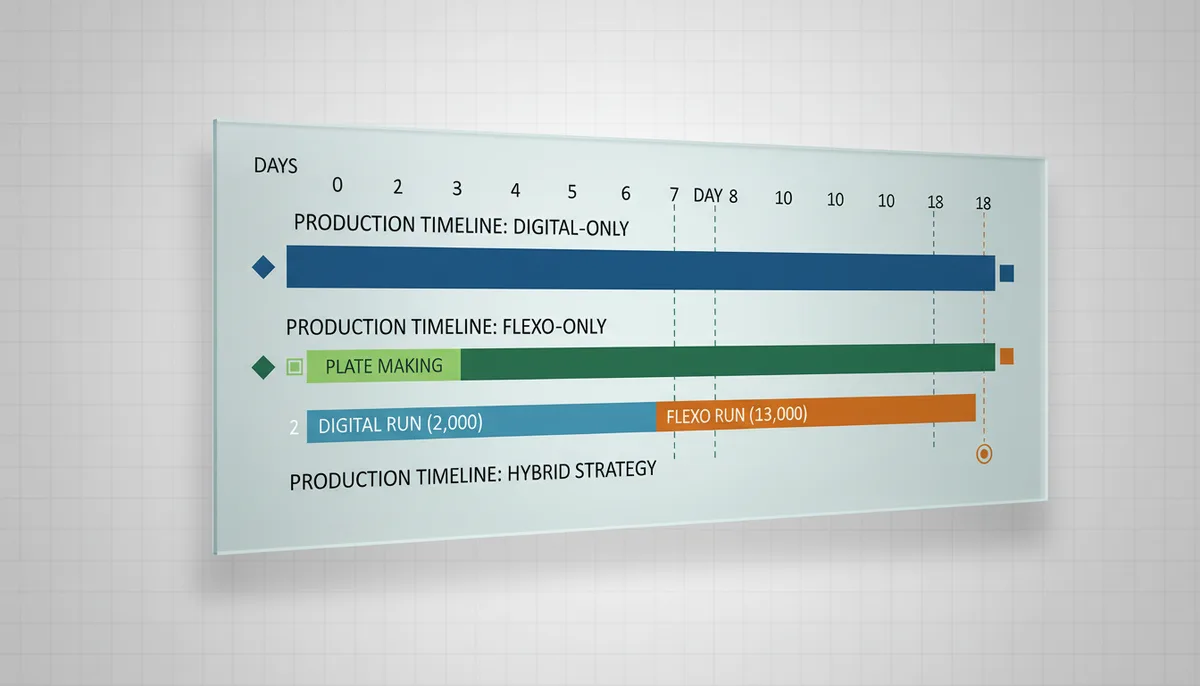
The Mistake (Flexo-Only): Client orders all 15,000 via flexographic. For fast label printing applications, this is especially relevant. Timeline: 2 days proofing + 3 days plate-making + 1 day printing + 2 days finishing/ship = 8 business days (≈11.5 calendar days). This seems fine within 4 weeks. But—a typo is found after plates are made. Correcting it requires new plates (+3 days, +$800), blowing the deadline.
The Strategic Approach (Hybrid): Client orders 2,000 labels digitally for initial stock. Timeline: 2 days proofing, print, and finish. They run these, confirm everything is perfect, then authorize the flexographic order for the remaining 13,000. The digital run acts as a live, large-format proof. The total cost is slightly higher, but the risk of a catastrophic, deadline-breaking error is near zero. This is how savvy brands use fast label printing tactically.
"For a recent toy launch, we used digital for the first 3,000 units to hit a trade show deadline, then switched to flexo for the 50,000-unit main production run. It cost 12% more overall but secured $250,000 in pre-orders we would have missed." — Client Solutions Architect
Need a Fast Quote for Your Label Project?
Leverage our internal data from 500+ jobs. For fast label printing applications, this is especially relevant. Share your specs and target deadline for a detailed commercial label printing companies comparison and a process recommendation tailored to your speed and volume needs.
Request a Speed-Optimized QuoteThat said, this approach is not ideal for every scenario. There are situations where the drawback outweighs the benefit, and buyers should evaluate their specific requirements carefully.
Future-Proofing Your Label Supply Chain
Looking to 2026, speed will be defined by integration, not just machinery. For fast label printing applications, this is especially relevant. The most resilient brands are building partnerships, not just placing orders.
When evaluating custom label printing companies, assess their digital infrastructure. Can their systems connect via API to your ERP for automated reordering? Do they offer inventory management programs where they hold blank or semi-finished label stock, printing and shipping on-demand? This "print-on-demand" model, supported by digital presses, is the ultimate expression of fast label printing, reducing lead times to 48 hours for recurring needs.
Also, consider geographic strategy. For fast label printing applications, this is especially relevant. While printing label near me offers logistical speed, a global partner with distributed facilities can offer redundancy. For example, a supplier with plants in Asia and North America can produce your labels in both regions, qualifying artwork once but producing locally to avoid tariff delays and reduce shipping time and cost. The future is about networked speed, resilience, and maintaining brand consistency across all production sites.
Ultimately, achieving reliable fast label printing is less about finding the fastest press and more about partnering with a commercial label printing company that has mastered the entire workflow — from your uploaded file to the dock door. By applying this framework, you can make informed decisions that balance speed, cost, and quality for all your printed custom labels in 2026 and beyond.
For more on building a resilient labeling strategy, explore our pillar page on promotional goods packaging solutions or our detailed analysis in shipping labels printing for logistics. To understand the full cost dynamics, read our commercial label printing cost analysis guide.
Frequently Asked Questions
What is the exact breakeven quantity for ordering custom printed labels digitally vs. flexographically?
The breakeven point for total cost and effective speed typically falls between 4,000 and 7,000 labels, depending on color count. For runs under 5,000, digital printing on equipment like an HP Indigo offers a 3-5 day lead time. For volumes over 10,000, flexographic printing on a 6-Color Rotary press becomes more cost-effective, despite a 10-14 day timeline for plate production.
What material specification prevents the most common 48-hour delay when ordering labels?
The #1 cause of a 48-hour stall is not specifying the liner type. To avoid this, provide the complete material spec: e.g., '2-mil BOPP face stock with permanent acrylic adhesive on a 60# white kraft liner.' This allows the printer to order materials immediately instead of pausing to ask for clarification.
When is searching for 'printing label near me' strategically better than using a national provider?
A local provider ('near me') is advantageous when you need logistical speed for urgent, last-minute orders under 5,000 units, as it can reduce shipping time to 1-2 days. For larger, planned runs over 10,000 units or for projects requiring geographic redundancy, a national provider with multiple facilities and API-driven inventory management offers better long-term resilience and cost control.
How does authorizing a digital PDF proof impact the timeline for custom label printing?
Authorizing digital PDF proof approval in your initial purchase order can bypass 1-2 business days required for shipping and reviewing a physical hard-copy proof. This step, combined with providing Pantone color references and a clean dieline layer, can reduce total pre-press back-and-forth by 2-3 days, accelerating your 3-5 day digital print run.