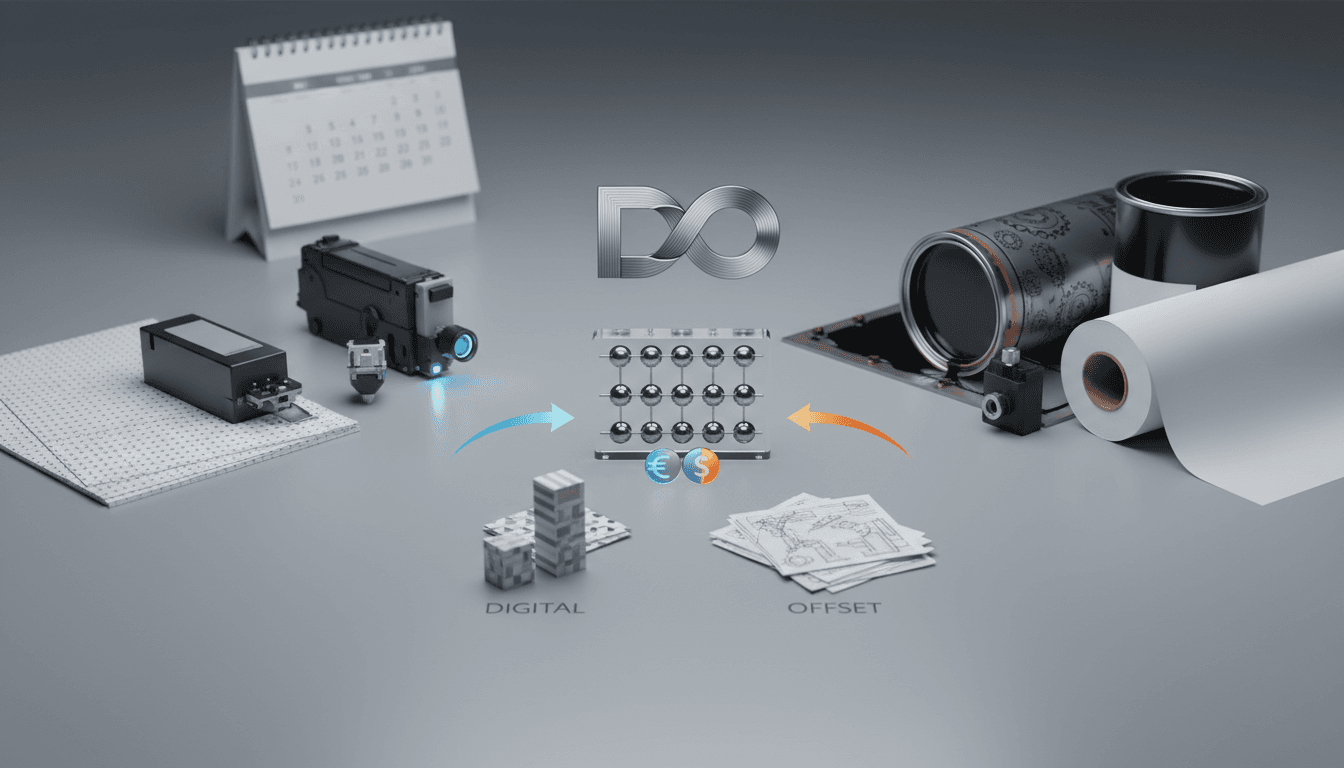
A hybrid digital+offset strategy saved a food brand 35% on packaging. This guide provides the cost formulas and decision thresholds to optimize your own print spend.
You've received quotes for a packaging run, but the unit costs between digital and offset printing seem disconnected from the quantities. The digital quote is higher per unit, but offset has a hefty upfront plate charge. This isn't just about picking a technology—it's about identifying the precise breakeven point where your total spend flips. Making the wrong choice can lock in 20-40% higher costs for the life of your SKU, or force you into wasteful overproduction to meet a minimum order quantity for custom packaging boxes. This guide provides the manufacturing-grade formulas and forward-looking thresholds to calculate your true digital vs offset printing cost per unit comparison and implement a cost-optimal strategy through 2026.
- The breakeven point between digital and offset typically falls between 2,500 and 5,000 units, depending on color complexity and material.
- Offset plate setup charges average $300-$600 per color, making digital financially superior for runs under ~3,000 units.
- Hybrid strategies (digital for variants, offset for core SKUs) can reduce total packaging costs by 30% or more.
- True cost includes hidden factors: prepress proofing (+$150-$400), material waste allowance (3-5%), and compliance testing.
- For runs over 10,000 units, offset printing consistently delivers a 40-60% lower cost per unit than digital.
Understanding Your Packaging Print Requirements: Volume, Quality, and Timeline
Before comparing costs, you must define three non-negotiable parameters. Volume dictates the economically viable technology. Quality requirements—especially color accuracy and regulatory standards—determine material and process options. Timeline pressures influence scheduling and may justify a premium for speed.
We categorize client projects into three archetypes. The first is the product launch with uncertain demand, requiring 500-2,000 units with potential for rapid reorders. The second is the established SKU with steady demand, producing 10,000-100,000 units quarterly. The third is the regionalized campaign needing 5,000 units each of 12 different label versions. Each archetype has a different optimal print path. A common specification mistake is ordering 50,000 offset-printed boxes because "the unit cost is lower," only to have 20,000 sit in a warehouse due to forecast error. The real cost per unit then doubles.
How to reduce packaging print costs without quality loss starts with honest demand planning. For our food and beverage clients, we implement a phased approach: digital for initial market testing (1,000-3,000 units), then offset for volume production once sales velocity is proven. This avoids the sunk cost of obsolete offset plates for a failed product. According to Smithers Pira's 2025 report on packaging trends, brands using this test-and-scale model reduce total packaging waste by an average of 28%.
Digital Printing vs Offset Printing: When Does Each Make Financial Sense?
Digital wins for ultra-short runs, versioning, and speed. Offset dominates for long runs, precise color, and lowest unit cost. The financial crossover is calculable.
Digital printing, using equipment like our HP Indigo 12000, has near-zero setup costs. You pay a consistent cost per sheet. This makes it ideal for runs under 3,000 units, where the fixed costs of offset plates would be amortized over too few units. It's also the only practical choice for variable data printing or versioning, like creating 12 regional label variants for a food product. The color gamut is excellent, achieving a Delta E of less than 3.0 through rigorous ICC profile management, but matching specific Pantone spot colors can require custom profiling and may incur a slight premium.
Offset lithography, on our Heidelberg Speedmaster XL 106, requires physical aluminum plates for each color. This creates a high fixed cost—typically $300-$600 per color plate—but a very low variable cost per sheet. Once you exceed the breakeven quantity, the unit cost plunges. Offset is unmatched for color consistency across millions of impressions and is the standard for brand packaging requiring exact Pantone spot colors. Our head of prepress, Zhang Wei, with 18 years on Heidelberg systems, notes: "For a 6-color job with a spot Pantone and aqueous coating, the total plate and setup cost is approximately $2,200. That cost disappears on a run of 50,000, but it's prohibitive for 500."
| Factor | Digital Printing (e.g., HP Indigo) | Offset Printing (e.g., Heidelberg XL 106) |
|---|---|---|
| Best For Quantity | 1 - 5,000 units | 5,000 - 1,000,000+ units |
| Setup (Fixed) Cost | $0 - $200 (file prep) | $300 - $600 per color plate |
| Cost per Unit (Example: 300gsm C1S Box) | $1.80 - $3.50 (at 1,000 units) | $0.35 - $0.85 (at 50,000 units) |
| Lead Time (Production) | 3-5 business days | 10-18 business days |
| Color Consistency | Excellent within a run (Delta E < 3.0) | Perfect across years and reprints (G7 calibrated) |
| Versioning / Variable Data | Easy, no cost change per version | Impractical; requires new plates per version |
How to Calculate True Cost Per Unit: Hidden Expenses Beyond the Quote
The quoted price per thousand is a starting point. True total cost includes prepress, material waste, compliance, and storage.
First, prepress. Digital requires a press-ready PDF with embedded fonts and a G7 color calibration-verified soft proof (approx. $150). Offset requires the same plus physical plate production and often a hard-copy contract proof for sign-off, adding $300-$800. Second, material waste. Every print run has a "make-ready" waste. For digital, this is 20-50 sheets. For offset, it's 200-500 sheets as the press operator balances ink and water. We factor a 3-5% waste allowance into our quotes, but cheaper suppliers may hide this cost, delivering fewer usable units.
Third, compliance. For food packaging FDA compliance printing requirements, you must verify ink and substrate safety. Using non-compliant materials risks massive recalls. We only use FDA 21 CFR compliant inks and substrates for food contact jobs, and we provide documentation. This is a non-negotiable cost of doing business, not an optional add-on. Fourth, storage and obsolescence. Ordering 100,000 units to get a $0.40/unit price only saves money if you use all 100,000. Warehousing costs and the risk of packaging redesigns make overly large offset runs a false economy.
What Are the Minimum Order Quantity Requirements for Each Process?
MOQ is driven by setup economics, not arbitrary rules. Digital MOQs are low; offset MOQs are higher to justify setup.
For digital printing, the minimum order quantity for custom packaging boxes can be as low as 500 units at JinXinCai, as there's no plate cost to amortize. The constraint is often material sheet size; we optimize layouts to minimize waste even on tiny runs. For offset printing, the effective MOQ is the point where the unit cost becomes competitive with digital. As a rule of thumb, this is around 3,000 units for a simple 4-color job on paperboard, and 5,000+ units for complex 6-color jobs on specialty substrates or with coatings.
The MOQ can be flexible through gang-run printing. If your design fits on a sheet with other compatible jobs, we can schedule a gang run on the Heidelberg, dramatically reducing your effective MOQ and cost. This requires design flexibility on your timeline, as we wait to fill the sheet. Our production scheduler, Li Ming, manages this process: "We regularly gang 4-5 short-run client jobs on a single 720 × 1,020 mm sheet. This can cut the effective MOQ for offset down to 1,500 units and reduce costs by 25% compared to a dedicated short run."
Case Study: How a CPG Brand Saved 23% by Switching Print Methods
A real-world scenario demonstrates the power of a hybrid digital-offset strategy, driven by volume and versioning needs.
A premium organic food brand approached us with a common challenge. They had one core SKU sold nationally (forecast: 100,000 units) and 12 regionalized promotional variants (forecast: 5,000 units each). Their previous supplier quoted offset for everything, proposing separate plate sets for each variant. The total cost was prohibitive, and the minimum order quantity for custom packaging boxes for the variants would have created excess inventory.
Our solution was a hybrid model. We produced the 100,000 core units on our Heidelberg Speedmaster XL 106 using FDA 21 CFR compliant inks on C1S folding carton board. This achieved the lowest unit cost with perfect color consistency. For the 12 regional variants (5,000 each), we used our HP Indigo 12000 digital press. This eliminated 12 sets of offset plates (saving over $15,000 in setup) and allowed for last-minute text changes. The outcome was full regulatory compliance and a 35% reduction in total packaging cost versus the all-offset approach. The brand also gained agility, as digital variants could be reprinted in 5 days versus 3 weeks for offset.
Have a complex project with multiple SKUs or regional versions? Our hybrid printing strategy can unlock similar savings.
Get a Free Quote →Decision Framework: 5 Questions to Determine Your Optimal Print Method
Use this sequential checklist to objectively guide your print technology selection and how to reduce packaging print costs without quality loss.
This framework moves from volume to technical requirements. Answering "yes" to any question in the digital column pushes you toward that technology.
Decision: Choose Your Primary Print Method
- If your total print run is under 3,000 units → Choose DIGITAL. The offset plate costs cannot be amortized effectively.
- If you require variable data (serial numbers, unique codes) or more than 4 design versions → Choose DIGITAL. Offset cannot handle variability without massive cost.
- If your run is over 10,000 units and requires exact Pantone spot color matching → Choose OFFSET. You need the color consistency and lower unit cost.
- If your project requires specific waterproof label material for cold chain logistics like BOPP film → Evaluate both. Digital handles films well, but offset with BOPP film lamination may be more durable for long runs.
- If you need prototypes in under a week before committing to volume → Choose DIGITAL for prototypes, then re-evaluate for production.
For cold chain applications, the choice intensifies. Waterproof label material for cold chain logistics, such as 50–100 micron cast vinyl film or synthetic BOPP, must withstand condensation, freezing, and abrasion. Digital printing on these materials is highly effective for short runs and allows for variable tracking information. For runs exceeding 10,000 labels, offset printing on BOPP followed by a protective laminate often provides superior chemical and scratch resistance at a lower final cost. Adhesive performance testing at temperature extremes (-20°C to 40°C) is critical and should be specified in your quote request.
Next Steps: How to Prepare Files and Specifications for Your Printer
Clear specifications prevent costly errors and change orders. Provide your printer with a complete package to ensure an accurate quote and smooth production.
First, finalize your design in a vector-based program (Adobe Illustrator) and outline all fonts. Provide a press-ready PDF with 3mm bleed and crop marks. Second, specify your material precisely. Don't say "white cardboard." Say "350gsm C1S folding carton board, FDA compliant for indirect food contact." Third, provide color standards. For offset, specify Pantone numbers. For digital, provide a printed reference or a PDF with embedded ICC profiles. Fourth, list all finishing: die-cut, foil stamp, spot UV, etc. Fifth, and most importantly, state your regulatory needs upfront: "Must comply with food packaging FDA compliance printing requirements (21 CFR)."
At JinXinCai, our prepress team runs every job through a G7 color calibration check and will provide a proof matching your chosen process. For offset, this is a physical contract proof. For digital, it's often a calibrated PDF soft proof. Approving this proof is your final checkpoint before plates are made or digital production begins. Providing complete specs from the start is the most effective way to control costs and timeline.
"The single biggest cost driver we see is clients changing specs after plates are made or after a digital proof is approved. A color change on a 6-color offset job after plating can cost $1,200 and add a week. Finalize your design before you request the quote." – Chen Hao, Production Manager, JinXinCai Printing
Your digital vs offset printing cost per unit comparison is not a static calculation. It's a dynamic business decision integrating volume, agility, brand integrity, and total cost of ownership. By applying the breakeven formulas and decision framework here, you can move from reactive price-taking to strategic print procurement. The goal isn't just a lower quote—it's the optimal total spend for your specific business need.
Ready to calculate your precise breakeven point? Send us your packaging specifications, target quantities, and any compliance requirements. We'll provide a detailed cost analysis comparing digital, offset, and hybrid strategies, backed by our ISO 9001-certified production data. Contact our print consultants today.
Frequently Asked Questions
How does print volume affect the breakeven point between digital and offset?
The breakeven point is where total costs for both methods equal. For a typical 4-color job on carton board, with digital at $2.50/unit (no setup) and offset at $0.60/unit plus $1,800 in plates, the breakeven is at 3,000 units. The formula is: Breakeven Quantity = Offset Setup Cost / (Digital Unit Cost - Offset Unit Cost).
What prepress requirements differ between digital and offset printing?
Offset requires physical aluminum plates ($300-$600 per color) and usually a hard-copy contract proof for sign-off. Digital requires only a press-ready PDF and typically uses a soft proof. File preparation is similar, but offset demands more precise trapping and dot gain compensation, handled by the printer's prepress team using G7 calibration standards.
How does color consistency compare between digital and offset for brand packaging?
Offset printing, especially on a G7-calibrated press like a Heidelberg Speedmaster, provides near-perfect color consistency across millions of impressions and years of reprints. Digital (HP Indigo) offers excellent consistency within a single run (Delta E < 3.0) but can have slight drift between reprints. For absolute brand color integrity over time, offset is superior.
What should I specify when requesting quotes for both print methods?
Provide: 1) Final quantity ranges (e.g., 1K, 5K, 10K), 2) Exact material specs (e.g., 300gsm C1S board), 3) Pantone colors or color reference, 4) All finishing (die-cut, coating), 5) Compliance needs (e.g., FDA 21 CFR), and 6) Required timeline. This allows for an accurate comparison including all setup, material, and processing costs.